
Bracelet; Gold foil
Description
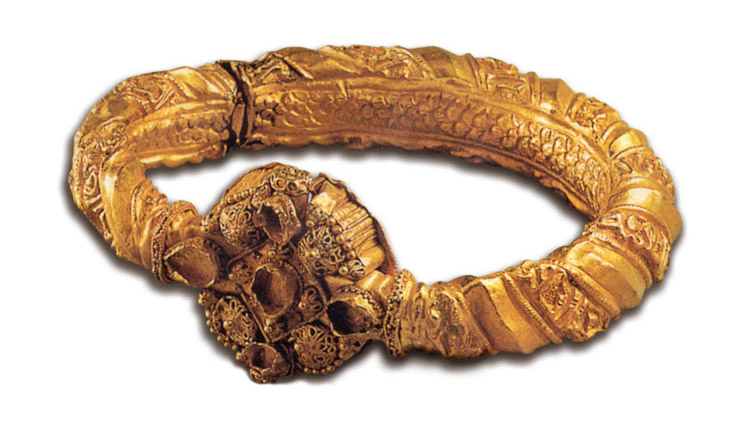
Many techniques for the manufacture of gold were known in Syria, some appearing as early as the 2nd century BC. This armlet may look extremely heavy, but it actually consists of gold leaf into which decorations were hammered from the inside before it was twisted into a hollow tube around wire. The seam where the two edges meet is disguised by a decorative band.
Inscription bands in kufic script, alternating with bands of gold cut on an angle, wind around the piece. The inscription is placed within an arrangement of vegetal patterns, the text of which may be translated as follows: “Extensive grace, full blessings, and enduring greatness”.
A hinge, seen on the left side of the picture, enables the bracelet to open when the draw-pin clasp, disguised by gemstones, is undone. The clasp itself has settings for four stones, all of which are missing. It is elaborately decorated with filigree domes, spherical granules, and tiny twisted ropes of gold.
This bracelet is one of a pair the other is in the collection at the Freer Gallery of Art in Washington. They differ only with respect to the inscriptions, which are similar in spirit but differ in wording, intended to bestow good luck on the wearer. The design and orientation of the inscriptions allow the wearer to read them without having to twist her wrists. A number of these phrases are found in pairs, and completing each other, so that a person could continue reading the inscriptions on both arms. It is also probable that a set would include bracelets and anklets similarly inscribed.
((Note the references section)




Leave A Comment