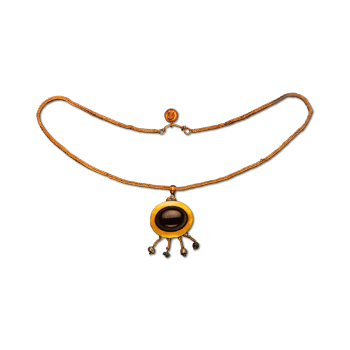
Gold and Agate Jewelry Piece

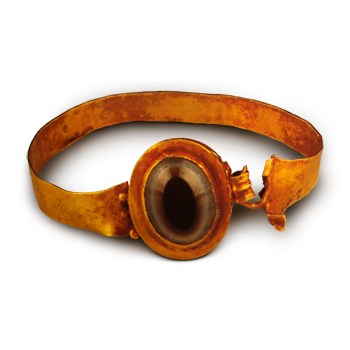
Gold and agate jewelry piece, 23 x 2.6 cm, Roman period. Large ornament with gemstone inlays. Syria. National Museum of Damascus, inv. 6014-, Dam 063-3.

Description

This elongated ornament, measuring 23 x 2.6 cm, is composed of gold and agate, demonstrating the prestige of jewelry craftsmanship in Roman Syria. Gold, though precious, was commonly used in jewelry for its ductility and ease of shaping; it could be mined as river nuggets or extracted from ores, particularly in the Caucasus region, the nearest gold source to Syria. Pliny the Elder attributes the earliest methods of gold processing to Phoenicians, emphasizing the Levant’s reputation in goldsmithing. Agate, valued for its banded layers of color, was imported from India and widely applied in ornaments of the Roman period. The size suggests this piece may have been part of a necklace or ceremonial adornment. It reflects the integration of local craftsmanship with international trade networks and the aesthetic values of the Roman world.
  • Site: UNKNOWN

  • Date: Roman period

  • Material: Gold and agate

  • Item Dimensions: 23×2.6 cm

  • Technique/Style of Manufacture: Goldsmithing with agate inlays; precious metal and semiprecious stone combination

  • Function: Decorative / Jewelry

  • Condition: Preserved; some expected wear

  • Archaeological Mission:

  • National Museum Of Damascus (2011) – Museum Number: DAMASCUS 6014-

  • VMS Code: Dam 063-3

Excavation Site Location

  • Ogden, Jack. Jewellery of the Ancient World. New York: Rizzoli, 1982.
  • Pliny the Elder. The Natural History. Vol. 6. Translated by John Bostock and H. T. Riley. London: Henry G. Bohn, 1857, bk. 33. Perseus Digital Library.
  • Strong, Donald. Roman Art. Prepared for press by J. M. C. Toynbee. 2nd ed., new impression, revised and annotated under the editorship of Roger Ling. New Haven: Yale University Press, 1995.

Your Content Goes Here

Your Content Goes Here

Your Content Goes Here

Not every record you will find here is complete. More information is available for some works than for others, and some entries have been updated more recently. Records are frequently reviewed and revised, We welcome any additional information you might have.

Record Completion 70%