
The Painted Panel Above the Torah Niche

Description
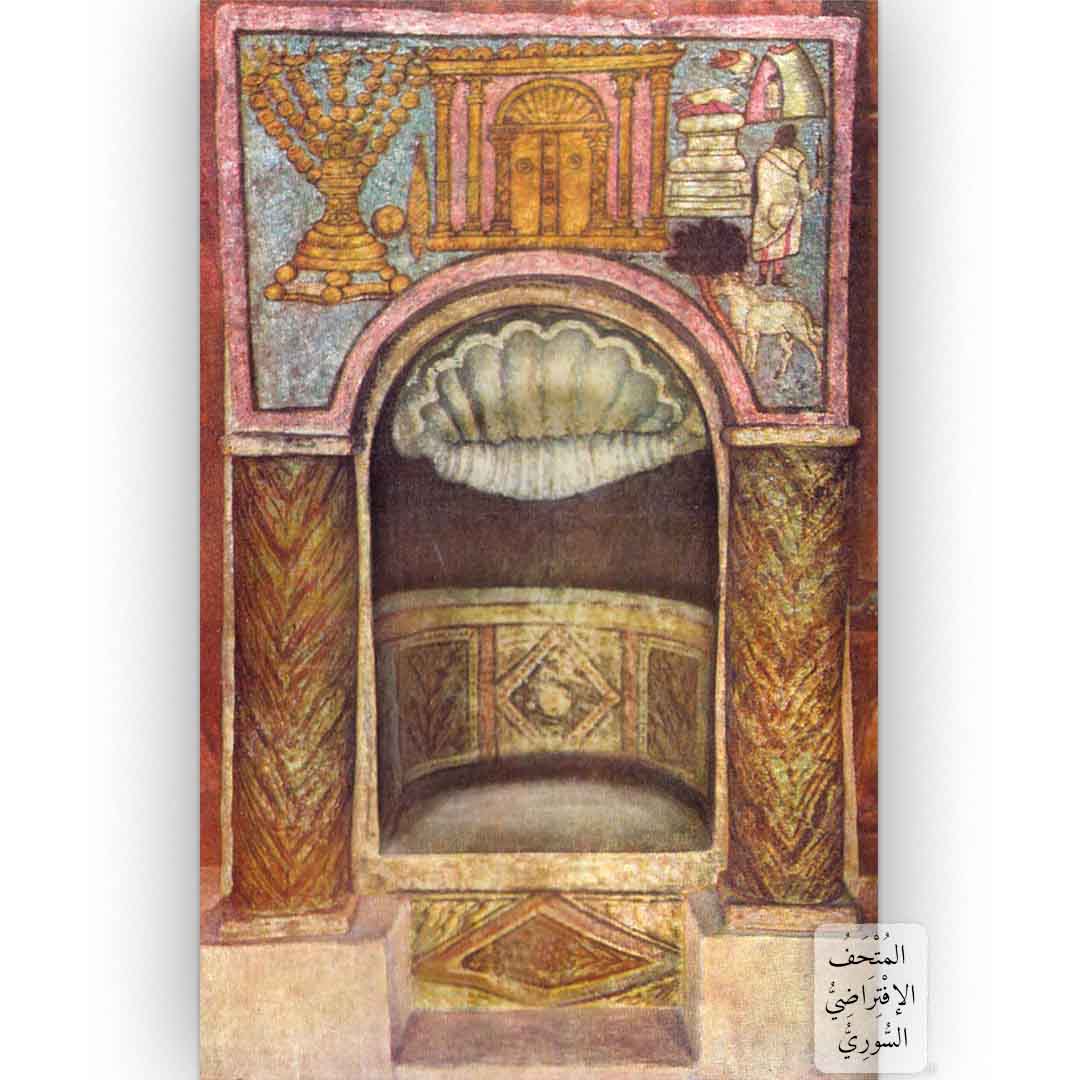
Occupying the central field above the Torah niche is one of the most complex compositions in the Dura-Europos synagogue. Unlike many of the surrounding frescoes, which present clearly framed episodes, this panel is visually dominated by a large vine- or tree-like motif that spreads across much of the painted surface. Branches, leaves, clusters of fruit, human figures, and symbolic elements appear across the painted surface, creating a densely layered image whose internal relationships have been the subject of considerable scholarly discussion.”
At the center of the panel rises the large vegetal motif from which numerous branches extend outward across the composition. Among its foliage appear several figures and symbolic elements. In the lower left, Jacob is shown seated while blessing his sons. A corresponding scene occupies the lower right, where Jacob blesses Ephraim and Manasseh. Above these scenes appear additional symbolic motifs, including a lion and a seated musician holding a lyre.
The relationship between these various elements is not immediately apparent. Unlike many of the narrative scenes elsewhere in the synagogue, which illustrate a single biblical episode within a clearly defined frame, the present composition brings together several subjects within a shared pictorial field. The extensive vegetal forms connect visually with the surrounding figures and symbols, producing a composition whose meaning has been the subject of considerable scholarly discussion. For this reason, the panel has often been interpreted as a symbolic composition rather than the illustration of a single biblical event.
The painting is executed in the same broadly linear style found throughout the synagogue. The figures are distributed across a shallow pictorial space with little attempt at perspectival depth, while the vegetation forms a dense visual network across the surface of the wall. Earth-toned reds, yellows, greens, and dark outlines define the principal forms and maintain visual clarity despite the complexity of the scene.
The panel occupies a particularly prominent position above the Torah niche and forms part of the central decorative zone of the western wall. Its combination of patriarchal figures, symbolic animals, vegetal imagery, and musical motifs distinguishes it from the surrounding narrative frescoes and makes it one of the most debated compositions within the synagogue.

Expedition copy of the central panel above the Torah niche. Yale University Art Gallery, Dura-Europos Collection.
Biblical Background
Several biblical traditions appear to be represented within this composition. The two scenes occupying the lower part of the panel are generally identified with episodes from the closing chapters of Genesis, where the patriarch Jacob blesses his descendants before his death.
In the lower left, Jacob is commonly understood to be blessing his sons, an episode recorded in Genesis 49. In this chapter, Jacob gathers the founders of the tribes of Israel and pronounces individual blessings and prophecies concerning their future:
“Gather yourselves together, that I may tell you what shall befall you in days to come.”
(Genesis 49:1)
The scene in the lower right is usually identified as Jacob blessing Ephraim and Manasseh, the sons of Joseph, as described in Genesis 48. According to the biblical account, Jacob deliberately places his right hand upon the younger Ephraim, granting him precedence over his elder brother:
“And Israel stretched out his right hand, and laid it upon Ephraim’s head, who was the younger…”
(Genesis 48:14)
The lion appearing in the upper part of the composition is often connected with Jacob’s blessing of Judah in Genesis 49, where the tribe of Judah is compared to a lion:
“Judah is a lion’s whelp; from the prey, my son, thou art gone up.”
(Genesis 49:9)
Beyond these specific references, the composition draws upon broader biblical imagery associated with genealogy, tribal identity, inheritance, and the continuity of Israel. The extensive vegetal forms visible throughout the panel have led many scholars to connect the imagery with scriptural metaphors in which Israel, the righteous, or divine blessing are represented through the imagery of trees, vines, and fruitful growth. While no single biblical passage accounts for all the elements shown here, the composition appears to combine several related traditions within a single visual field.

Grayscale rendering of the central panel above the Torah niche, presented to assist observation of surviving details and compositional relationships.
Iconographic Notes
The most striking feature of this panel is the extensive vegetal motif that occupies much of its surface. Branches, leaves, clusters of fruit, and curling tendrils spread across a large part of the register and today constitute its most visually dominant element. The relationship between this vegetation and the surrounding figures has long been debated. While some scholars have interpreted the panel as a unified symbolic composition, others have suggested that the vegetal forms belong to an earlier decorative phase to which some of the narrative elements were subsequently added.
Beneath and alongside the vegetation appear scenes commonly identified as Jacob blessing his sons and Jacob blessing Ephraim and Manasseh. Together with the lion and the seated lyre-player in the upper register, these figures introduce themes associated with the tribes of Israel, royal lineage, and biblical tradition. The lion is frequently connected with the tribe of Judah through Jacob’s blessing in Genesis 49, while the musician has often been identified as David. This latter identification, however, rests on iconographic comparison rather than inscriptional evidence and therefore remains open to discussion. Several scholars have also noted similarities between the figure and artistic conventions associated with Orpheus in the Greco-Roman world.
Particular attention has focused on the identity of the vegetal motif itself. Some scholars have interpreted it as a vine, others as a tree, while still others regard it as a symbolic combination of both forms. The prominence of the motif has encouraged interpretations that connect it with broader ideas of divine blessing, continuity, fertility, or the enduring identity of Israel.
Among the most influential interpretations is that proposed by Erwin R. Goodenough, who regarded the composition as one of the synagogue’s most important symbolic images. In his reading, the vine or tree was associated with themes of exaltation, divine favor, and the spiritual destiny of Israel. Other scholars have adopted more restrained interpretations, emphasizing instead the patriarchal blessings, the symbolism of Judah and David, and biblical traditions that compare Israel to a fruitful vine or tree. No single explanation has achieved universal acceptance, and the painting remains one of the most debated compositions in the synagogue.
Whether understood as a unified composition or as the result of multiple decorative phases, the panel brings together themes of ancestry, tribal identity, kingship, and continuity in a manner unique among the surviving paintings of the Dura-Europos synagogue. Its position directly above the Torah niche further underscores its importance within the decorative and religious program of the western wall, suggesting that these themes held a special significance for the community that commissioned and used the synagogue.








Leave A Comment