
Scenes Above the Torah Niche (Aron Kodesh)
Description
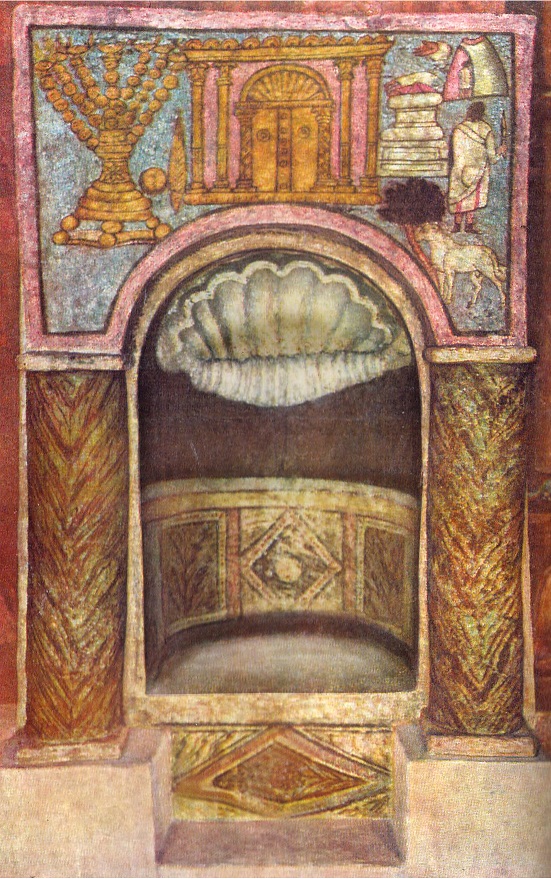
This group of images is positioned directly above the Torah niche and brings together three principal elements within a single visual field: the scene of the sacrifice to the right, a temple gateway at the center, and the Jewish menorah as a ritual object to the left. Their placement above the niche grants this section a distinctive importance within the arrangement of the western wall paintings, linking the biblical narrative with symbols associated with the Temple and Jewish worship.
On the right, the scene of the Sacrifice of Isaac is depicted. Abraham is shown from behind, raising the knife in his right hand above an altar on which his son Isaac lies prepared for sacrifice. Beneath the scene, the ram appears as the substitute offering, rendered at a noticeably larger scale than several surrounding elements. Its prominence reinforces its decisive role within the narrative. Behind the main action, a secondary figure dressed in white is also shown from the back, moving toward the entrance of a tent-like structure, separate from the central sacrificial event. Above the altar, an outstretched hand clearly signifies divine intervention without resorting to a direct anthropomorphic representation of God.
At the center of the composition stands a clearly defined architectural façade articulated as a formal gateway recalling the entrance of a sacred building. This element may be understood as a symbolic evocation of the Temple, or more broadly as a visual reference to sanctified space within the composition.
More precisely, this central feature consists of a building front elevated on four columns in a predominantly classical style. Above it runs a decorative frieze composed of semicircular motifs containing concentric rings, executed with careful ornamental detail. At its core, a large closed double door is framed by two columns supporting an arch, within which a shell motif is set. This shell form visually echoes the scalloped conch motif crowning the Torah niche below, establishing a direct visual relationship between the painted composition and the liturgical focus of the space.
On the left, a seven-branched menorah is depicted at a substantial scale, occupying an independent field within the composition. Its detailed rendering reinforces its role as a prominent ritual symbol.
All these elements are arranged within a shallow pictorial space, with minimal depth and no developed perspective. The figures and objects are placed on a single plane, using an earth-toned palette dominated by reds and ochres, with darker outlines reinforcing the contours of the figures and architectural forms.
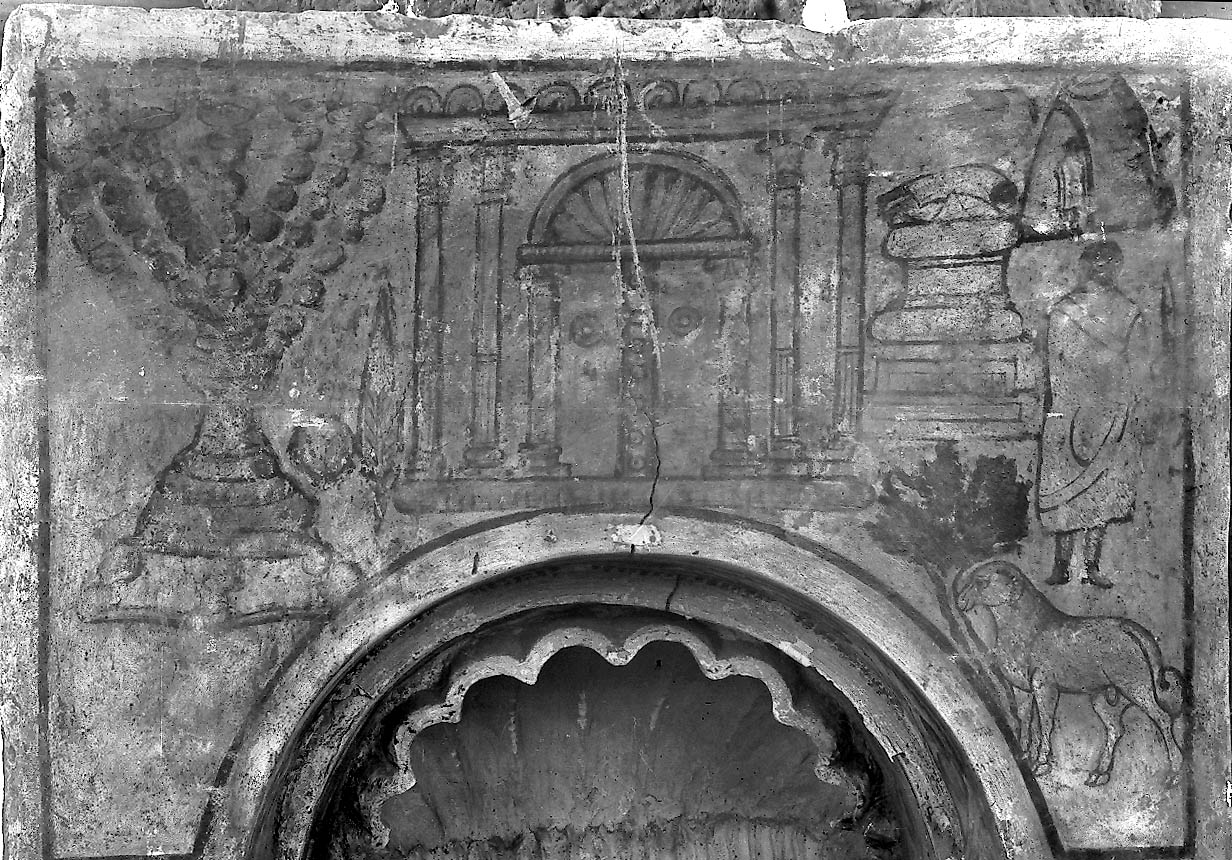
Archive image details the top of the arch above the Torah Niche. (Yale university)
Biblical Reference in Context
This portion of the composition draws upon the narrative of the Sacrifice of Isaac in Genesis 22, focusing on the climactic moment of divine intervention:
English (NRSV):
“Abraham reached out his hand and took the knife to kill his son. But the angel of the Lord called to him…” (Genesis 22:10–11)
The painter does not attempt a full narrative sequence, but instead isolates the moment of greatest tension, embedding it within a broader visual framework.
Iconographic Notes
This group of images differs from most other painted scenes in the synagogue in the way its elements are organized across the wall surface. Whereas many of the surrounding frescoes are separated by painted frames or clearly defined architectural borders, the three components above the Torah niche — the Sacrifice of Isaac, the Temple façade, and the menorah — are brought together within a single uninterrupted field. Their placement directly above the niche creates a close visual relationship between the biblical narrative and the liturgical focus of the synagogue below.
The scene also avoids any attempt at constructing a realistic spatial setting. The figures and architectural elements are arranged across a shallow pictorial surface with only limited overlap and without consistent perspectival depth. Scale likewise serves symbolic rather than naturalistic purposes. Most notably, the ram is rendered at a relatively large size compared to several of the surrounding figures, reinforcing its role as the substitute sacrifice within the narrative.
Divine intervention is indicated through the motif of the outstretched hand above the altar, without any direct anthropomorphic representation of God. Yet the position of this hand within the composition is also significant, since it stands in direct visual alignment with the curtain or tent-like structure toward which the secondary figure in white is moving at the upper right of the scene. This relationship has led some scholars to interpret the two details together rather than separately.
In several early Jewish and Christian interpretive traditions associated with the Akedah, Isaac is understood not merely as spared from sacrifice, but as having symbolically passed through death before being restored to life. Building on such traditions, Margaret Barker proposed that the figure entering behind the curtain may allude to Isaac entering the divine presence, particularly since the curtain itself recalls imagery associated with the veil of the Temple and access to the sacred realm. While this interpretation remains hypothetical, it derives from actual visual relationships within the scene rather than from isolated symbolic speculation.
The placement of these elements directly above the Torah niche further emphasizes the importance granted to the Sacrifice of Isaac within the western wall arrangement, especially through its deliberate association with Temple imagery and Jewish ritual symbols.
State of Preservation
The panel is preserved in relatively good condition in its principal outlines and key elements, although some finer details have been lost, particularly in lighter pigment areas and background sections. Despite this, the relationships between the three main components remain sufficiently clear to allow a coherent reading of the composition.
Conclusion
Positioned directly above the Torah niche, this composition occupies a central role within the organization of the western wall. The choice of the Sacrifice of Isaac in this location appears deliberate, aligning with themes of covenant, obedience, and substitution that resonate with the liturgical function of the space. Its association with both ritual and architectural elements further situates the scene within a broader conceptual framework tied to sanctity and religious institution, rather than limiting it to a purely narrative function.
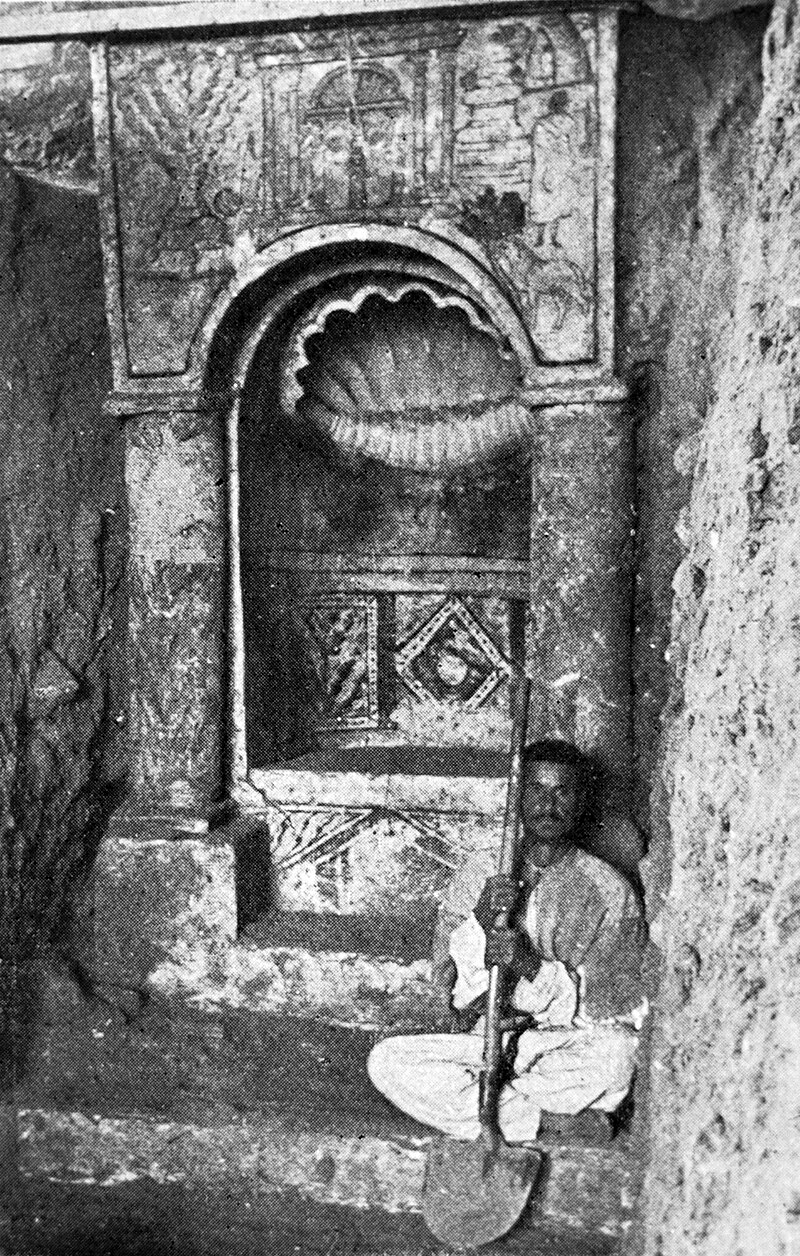
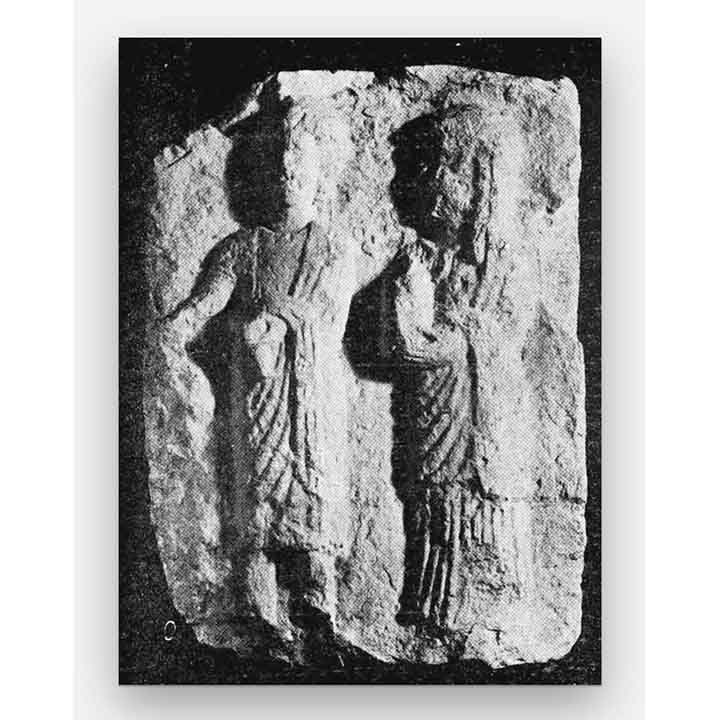
Archived picture; A Syrian worker at the excavations of the Torah Niche. (Yale university)










Leave A Comment