
Base relief representing the Deity Helios

Description
This high relief was found at Khirbet al-Tin near Homs, according to the museum record. Other publications have proposed different origins, including Palmyra or Emesa, but these attributions remain uncertain.
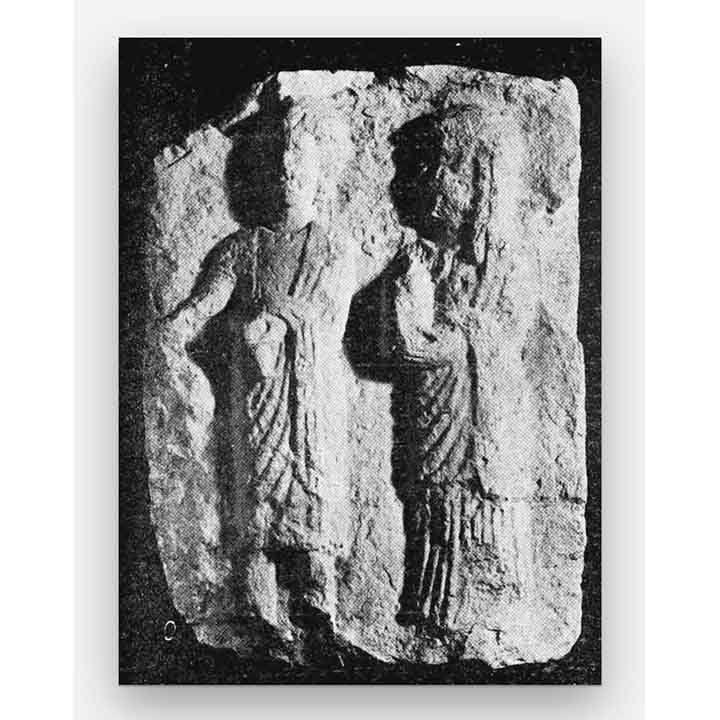
It depicts Helios, the Greek god and personification of the Sun, as a frontal bust surrounded by radiating rays and framed with vegetal decoration. In Roman Syria, Helios was sometimes associated with local solar deities such as Malakbel and Baalshamin.
Below the bust, seven figures appear in profile, facing toward the center. They may represent the seven planets, although this interpretation remains uncertain. The Greek inscription records that Marcus Claudius dedicated the relief to Helios, “the greatest god,” in fulfillment of a vow. It dates the dedication to 30–31 CE.
The radiant halo surrounding the god’s head is of pre-Christian origin and expresses his solar nature. Similar visual forms were later adopted in Byzantine and Christian art, where the halo became an attribute of Christ, the Virgin Mary and the saints.
The Greek writing on the base of the relief reads
Ἡλίωι θεῷ μεγίστωι Μᾶρκος
Κλαύδιος εὐχὴν ἔτους τμβʹ.
Translation
“To Helios, the greatest god, Marcus Claudius [dedicated this] in fulfillment of a vow, in the year 342.”








Leave A Comment