Description
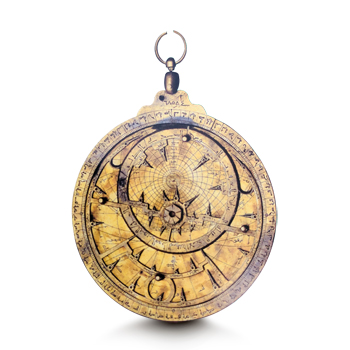
The astrolabe is the observation instrument that best represents Arab astronomy. The oldest known astrolabes come from the Islamic world, dating back to the ninth century. Over 1200 examples have survived. The astrolabe was used to determine the direction of Mecca. The instrument consists of a circular plate with a raised graduated ring fixed to its circumference. The surface of the plate is incised with lines representing azimuths and altitudes in relation to the location of the observer. Set above the plate is a set of revolving rings with small pointers around the edges to indicate the direction of the major stars, whose names are inscribed on the rings themselves. The arc of a circle in the lower part represents the equator. The straight bar going across the middle indicates the Sun’s elliptic and turns around a point representing the North Star. On the other side of the astrolabe, the surface is divided into four concentric circles inscribed with the months of the years, a graduated scale marked by letters and lines, the signs of the zodiac and, on the outermost circle, a moveable graduated scale marked with Arabic letters and lines. Instructions written on the central part tell the user how to hold the astrolabe.





Leave A Comment