
The seven djinns of Bet Pasi’el

Description
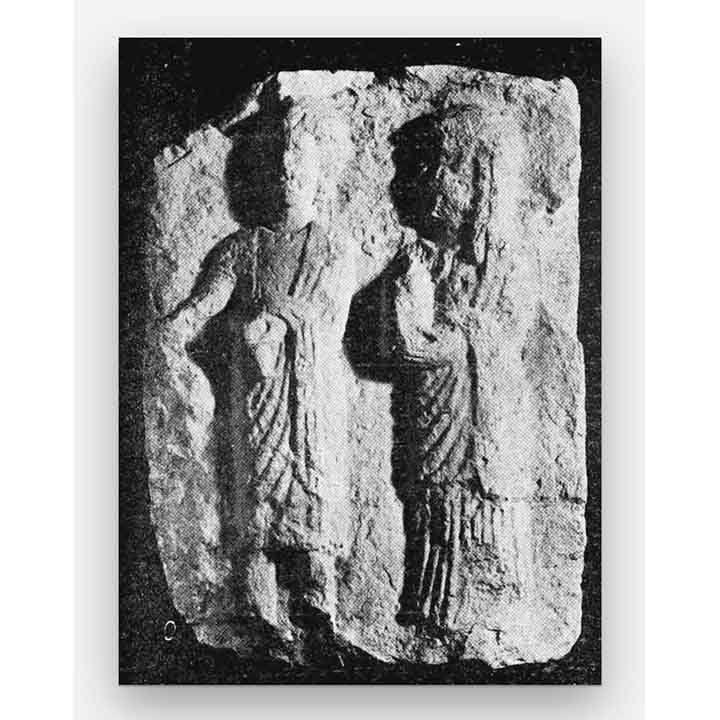
On this relief, found in a village outside of Palmyra, six identical warriors, clad in desert fashion, in robes bound below waist with a kind of apron, stand in a row between a goddess and a man offering incense . They are referred to collectively as “the genies of Bet Pasi’el”, protective spirits of the village so named. This is following the inscription that commemorates the erection in 191 of a stele representing “the good and bountiful genii of Beth Pha~iel”;
Perhaps the most popular God amongest thw simi nomadic-Beduin community dowelling around Palmyra would br Arsu. He, too, had a temple of his own. If not wearing armor and a bell‑shaped helmet, he looks like a desert camel‑rider in native dress, armed with a lance and shield. He is the most recognizable figure among many similar Bedouin gods riding horses or camels. They were mostly worshipped out in the steppe and bore Arab names such as Abgal, Azizu, Sha‘ad, Mun‘im, Shalman, etc. These names, which could also be used by men, are all meaningful: they
translate, approximately, as “Honored”, “Strong”, “Fortunate”, “Pleasant”, “Wholesome”.
They appear in pairs or in larger company and all look the same. A long gown half‑covered by a cloth fastened below
the waist was also worn by the Bedouin of the time, and their spears and small round shields were also the standard equipment of the nomads. It is often not possible to tell the desert gods from their worshippers.
They are mostly known from the countryside around Palmyra, peopled by recently settled Arab tribesmen. They are not frequently present in the city.
These modest village shrines often contained reliefs showing several gods in a bid to win the attention of as many supernatural beings as possible at one go. Sometimes there are two riders on camel or horseback, looking very much like caravan escorts or robber parties. Sometimes, just like here, we just see a line of identical figures collectively called the djinns (Aramaic ginnayya) of the place . Whenever the individual names are mentioned, their choice presumably reflected personal inclinations which might or might not have been shared by other people. Among all these warriors, only one goddess stands out. She is more or less convincingly depicted as Athena.









Leave A Comment