Relief of the Gods Ma’anû and Sa’adû

- The national museum of Damascus – متحف دمشق الوطني

Description

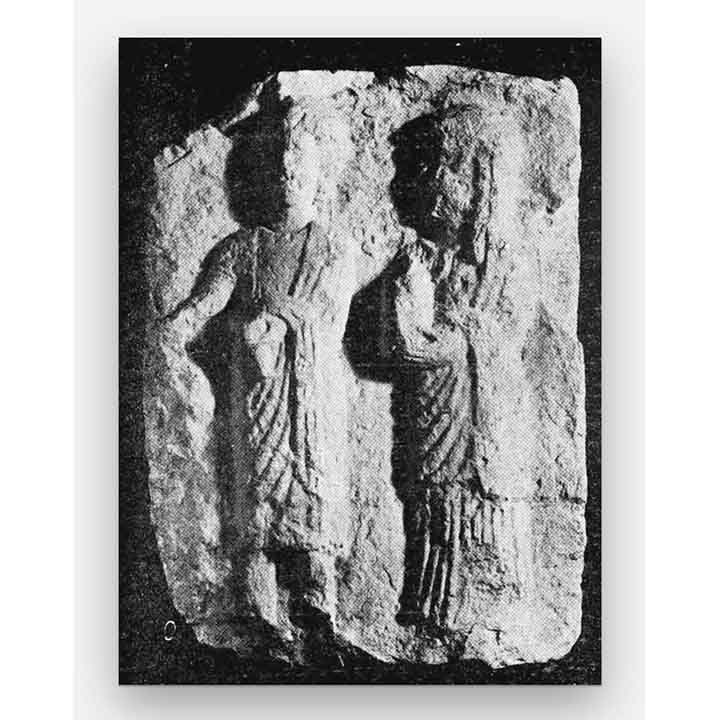
Relief from Ras ech Chaar. To the left the god Ma’anû  (Maan) mounted on a horse, to the right the god Sa’adû or Ašar, mounted on a camel.
Here Maan’s name is spelled m’nw. He is often invoked together with §’d(w), another Arab god.  Here in Ras esh-Shaar, for instance, the stele represents Maan holding a lance and riding a horse, whereas Saad rides a camel. Between the two figures the artist has portrayed the devotee offering incense; his name, Shimeon son of Maan son of Wartan, reveals a complex ethnic group, identified by a Jewish, an Arab, and a Persian name, respectively.
As well as Sa’dw, the God Maan was worshiped also with Abgal in the temple at Khirbet Semrin dedicated in I95.

  • Excavated from: Ras Cha’er (eCh Chaar) رأس الشاعر

  • Date:

  • Material: Limestone

  • Item Dimensions: 60 x 39 cm – Letters 13 mm

  • Archaeological Mission:

  • Inventory Number. 5069.  NATIONAL MUSEUM, DAMASCUS (2011) 

  • VMS Code: Dam 0194-3

Excavation Site Location

  • Meyer, Jørgen Christian. “Palmyrena: Settlements, Forts and Nomadic Networks.” In The World of Palmyra, edited by Andreas J. M. Kropp and Rubina Raja, 86–102. Scientia Danica, Series H, Humanistica 4, vol. 6; Palmyrene Studies 1. Copenhagen: Royal Danish Academy of Sciences and Letters, 2016.
  • Schlumberger, Daniel. La Palmyrène du Nord-Ouest: Villages et lieux de culte de l’époque impériale; Recherches archéologiques sur la mise en valeur d’une région du désert par les Palmyréniens. Bibliothèque archéologique et historique 49. Paris: Paul Geuthner, 1951, pl. XXVII, 3.
  • Teixidor, Javier. The Pantheon of Palmyra. Études préliminaires aux religions orientales dans l’Empire romain 79. Leiden: Brill, 1979.
  • أحمد، علي صقر. النقوش التدمرية القديمة. الجزء الأول، النقوش النذرية. دمشق: وزارة الثقافة، الهيئة العامة السورية للكتاب، 2009.
  • Published in PNO 35, p 154, pl. XXVII: 3 – PAT 1700, p  242

Not every record you will find here is complete. More information is available for some works than for others, and some entries have been updated more recently. Records are frequently reviewed and revised, We welcome any additional information you might have.

Record Completion 70%