
Mosaic Panel Depicting The Story Of Cassiopeia

Description
Cassiopeia was a mythical queen, known in Greek tradition as the wife of the king of Ethiopia and the mother of Andromeda. She boasted that her beauty surpassed that of the Nereids, the sea nymphs who were daughters of the sea god Nereus. Angered by her claim, Poseidon sent a sea monster to ravage her kingdom. Her daughter Andromeda was offered to the monster but was rescued by Perseus.
Discovered in the House of Cassiopeia at Palmyra, this mosaic presents a different version of the familiar story. Cassiopeia stands nude at the center of a circular composition, surrounded by the Nereids and holding the ends of a mantle behind her body. Rather than showing her punished for her pride, the scene presents her as the victor in a contest of beauty. A Greek inscription identifies the subject as the “Judgment of the Nereids,” while Cassiopeia’s name appears above her head.
The artist based her figure on representations of Aphrodite Anadyomene, particularly in the balanced stance, slight turn of the body, and raised arrangement of the hair. The surrounding marine company comprises five Nereids, five Erotes, and two marine centaurs. Their overlapping bodies, varied gestures, and expressive faces animate the densely arranged circular field.
This victorious representation of Cassiopeia departs from the usual mythological tradition. Only one comparable mosaic is known, discovered at Apamea.
The corners of the pavement were decorated with winged personifications associated with the changing seasons. Spring is the best-preserved figure. She wears a crown and necklace of intertwined flowers and is accompanied by a milk pail and a goat, attributes associated with fertility and the renewal of nature.
Some scholars have interpreted Cassiopeia’s victory as a symbol of cosmic order prevailing over the disorder of the waters. Others have proposed a Neoplatonic reading in which the removal of her mantle represents the soul casting off its bodily covering and moving toward immortality and absolute beauty. The mosaic is dated between 267/268 and 273 CE, the period during which the philosopher Longinus was present at Palmyra.
Part of the mosaic is displayed in the National Museum of Damascus under inventory numbers C4945 and 10939. The remaining sections were kept in the storerooms of the Palmyra Museum.
Inscription
Central medallion:
Κρίσις Ν[ηρεΐδων]
Κασσιέπεια
Corner panels:
Τ[ροπὴ —]
τροπ(ὴ) Ἐα[ριν]ή
[τροπὴ] Χειμεριν(ή)
Translation
“Judgment of the Nereids; Cassiopeia; Season [autumn or summer]; Spring; Winter.”

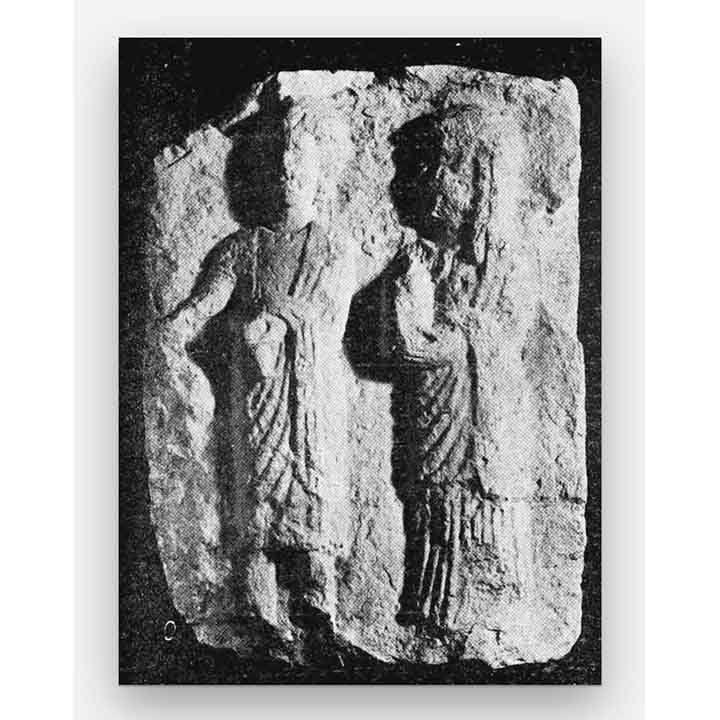
Winged female image represents one of the four seasons







Leave A Comment