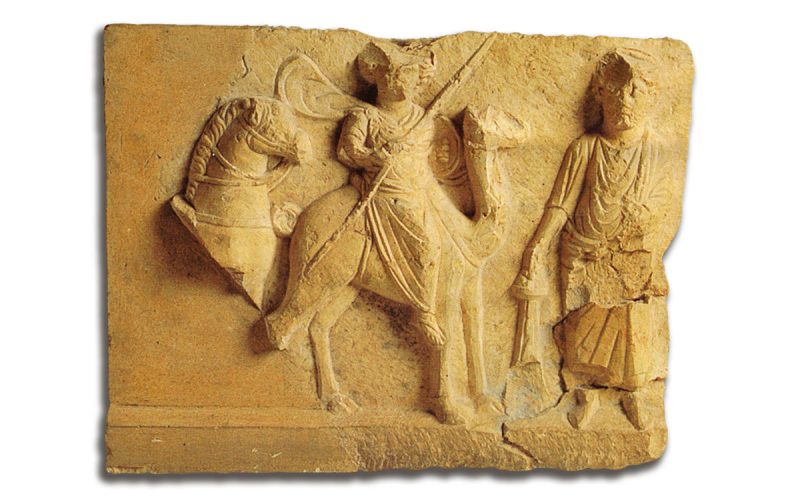
Bas-relief for Arsu

- The national museum of Damascus – متحف دمشق الوطني

Description

This bas-relief presents a rider — the god Arsu, the protector of caravans — mounted on a camel with a saddle, and also shows part of a horse wearing a harness and reins, suggesting that it, too, has a saddle. The camel was used for transporting merchandise and was rarely mounted, but the opposite was true of horses. The earliest representations of animals being ridden date to about 2000 BC; they show people mounted directly on the back of asses without any saddle. During the second millennium, a saddle of sorts appeared. Shortly after 1000 BC, bas-reliefs show horsemen sometimes riding bareback and sometimes mounted on a saddle. From then on, the use of saddles spread rapidly. With the Persian Empire, the saddle became established throughout Syria.

  • Excavated from: JEBEL BALAS

  • Date: AD 200

  • Material: Limestone 

  • Item Dimensions: 49 x 38.5 x 10 cm

  • Archaeological Mission:

  • National Museum Of Damascus (2011) – Inv Number : DAMASCUS 2624/5.247 

  • VMS Code Dam 0201

Excavation Site Location

  • Abdul-Hak, Sélim, and Andrée Abdul-Hak. Catalogue illustré du département des antiquités gréco-romaines au Musée de Damas. Damascus: Direction générale des antiquités de Syrie, 1951, 38, pl. 16:1.

Your Content Goes Here

Your Content Goes Here

Your Content Goes Here

Not every record you will find here is complete. More information is available for some works than for others, and some entries have been updated more recently. Records are frequently reviewed and revised, We welcome any additional information you might have.

Record Completion 70%