
Dedicatory Relief Depicting the God Abgal
Description
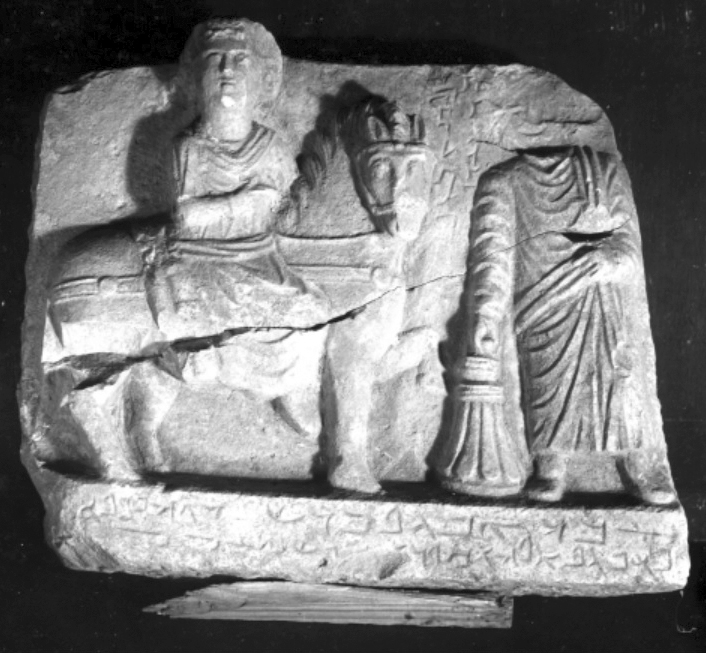
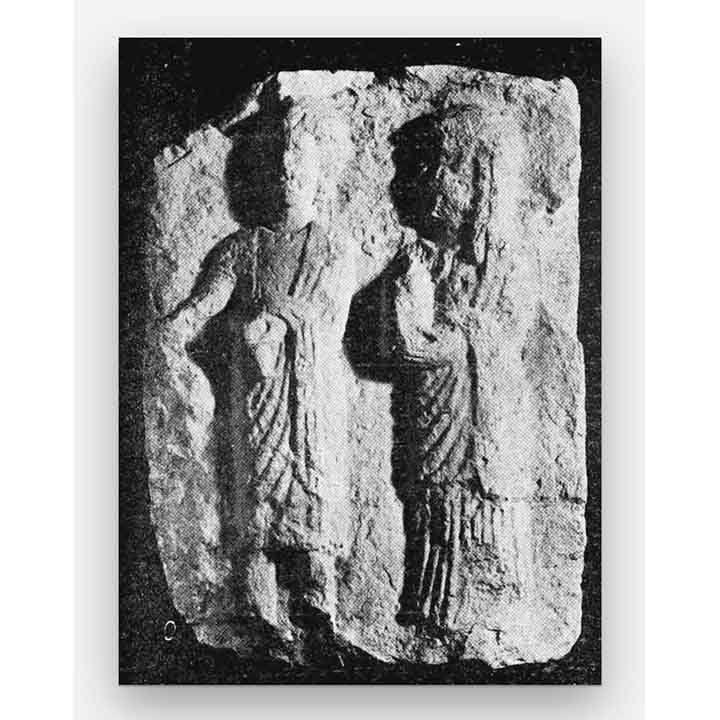
This dedicatory relief originates from the temple of Abgal at Khirbet Semrin, a major religious site in the northwestern steppe zone of Palmyrene territory. Though part of a widespread iconographic tradition, the piece remains a highly informative example of localized votive practice.
The composition is arranged in low relief and presents a sacred encounter. To the left, the god Abgal is shown mounted on horseback, occupying the larger portion of the scene and rendered frontally, emphasizing divine authority and presence. His figure is massive, with stylized garments and features that mark him as otherworldly. The horse, though somewhat schematized, is carefully executed and integral to the god’s image.
To the right, a standing male figure, most likely the dedicant, offers incense at a small altar positioned between himself and the god. Although the head of the figure is missing, the act of incense burning—evoking purity and communication with the divine—is clearly depicted. The accompanying inscriptions leave no ambiguity regarding his identity.
The Aramaic inscriptions are split into two registers:
- The upper reads: ṣlm ʾbgl br šʿrw (“Image of Abgal son of Shaʿru”).
- The base inscription: ʿbd ʾbgl br šʿrw hyklʾ lʾbgl ʾlhʾ mwddr šnt 510 (“Abgal son of Shaʿru built this temple for Abgal the god, to whom thanks are due, in the year 510”).
Significance
The relief records the founder of the temple, Abgal son of Shaʿru, in direct relation to his tribal deity. It materializes the intimate, reciprocal relationship between worshipper and divine protector—a common feature of Palmyrene steppe cults. As Toxidor notes, Abgal was a god of the steppes, largely absent from Palmyra proper but revered across the hinterlands.
In the inscriptions he is invoked as “god,” “good god,” “good and bountiful god,” “good protector,” “good and bountiful protector.”
The temple’s Greco-Oriental layout, with banquet rooms and a central cella, reflects regional religious synthesis. This relief is thus a key witness to the negotiation of sacred space and identity at Palmyra’s cultural frontier.








Leave A Comment