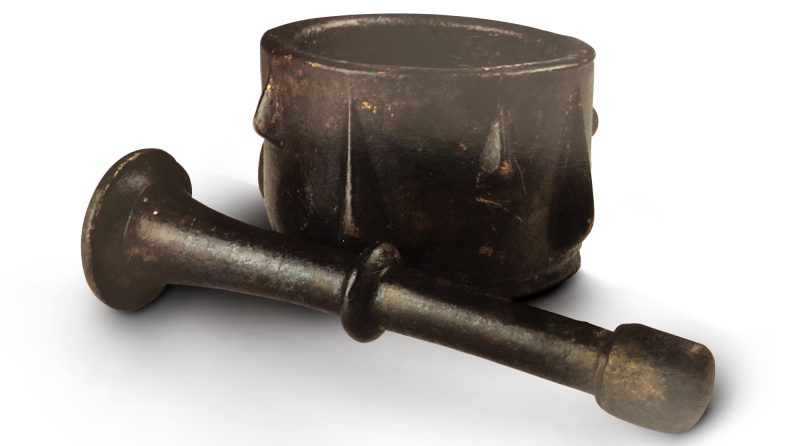
Mortar and pestle

- The national museum of Damascus – متحف دمشق الوطني

Description

When preparing medicines, Arab doctors often had to crush solid substances into powder so that they could be added to other ingredients. To do this, the doctors generally used pestles made of various materials such as stone, wood, ivory and glass. But the best-preserved pestles are those made of a metal alloy containing copper, zinc and lead, along with a bit of tin. Only a small quantity (two to three percent) of this metal was used, since it was very rare and expensive. Lead, on the other hand, was cheap and therefore constituted a high proportion of the alloy used to cast heavy mortars like this thick-walled one. However, lead made the alloy less hard and could even be toxic when the mortar was employed to prepare syrups containing the juice of fruits such as apples and pomegranates.
  • Site: RUSAFA, ANCIENT SERGIOPOLIS

  • Date: AD 900

  • Material: Four-metal alloy

  • Item Dimensions: 25 x 6.8 cm/14.5 x 11 cm

  • Archaeological Mission:

  • National Museum Of Damascus (2011) – Museum Number: DAMASCUS 13269 A

  • VMS Code: Dam 055-5

Excavation Site Location

  • Syria: land of civilizations / Michel Fortin; Musée de la civilisation (Québec) – Syria’s ministry of culture – 1999

Your Content Goes Here

Your Content Goes Here

  • Michel Fortin’s Syria, Land of Civilizations المديرية العامة للآثار والمتاحف – وزارة الثقافة، الهيئة السورية للكتاب (1999)

Not every record you will find here is complete. More information is available for some works than for others, and some entries have been updated more recently. Records are frequently reviewed and revised, We welcome any additional information you might have.

Record Completion 70%