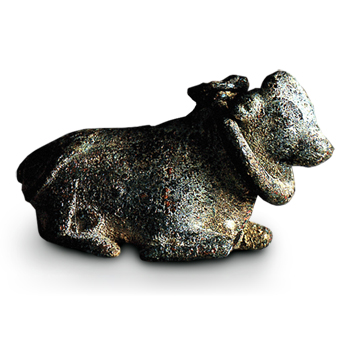
Cow suckling a calf

Ivory carving of a cow suckling a calf from Arslan Tash, 800 BCE, National Museum of Aleppo

Description

In the Near East, cows, as well as other animals such as goats, sheep and camels, were raised for their milk. This food is rich in fat, and fat was essential to the health of a population who, by our standards, lived very harsh lives indeed. On the basis of modern ethnographic studies, it appears likely that the people of the Near East developed simple methods of conserving milk products early on in their history, since such food goes bad very quickly in a hot climate. Fresh milk was turned into yogurt so that it could be kept for a few days. While the milk products themselves have disappeared, of course, the utensils used to prepare them have survived.


  • Site: ARSLAN TASH, ANCIENT HADATU

  • Date: 800 B.C

  • Material: Ivory

  • Item Dimensions:  11.5 x 5.7 x 1.6 cm

  • Archaeological Mission:

  • National Museum Of Aleppo (2011) – Museum Number ALEPPO M 817

  • VMS Code: Alp 0102

Excavation Site Location

  • Turner, Geoffrey. “The Palace and Bâtiment aux Ivoires at Arslan Tash: A Reappraisal.” Iraq 30, no. 1 (1968).

Your Content Goes Here

Your Content Goes Here

Your Content Goes Here

Not every record you will find here is complete. More information is available for some works than for others, and some entries have been updated more recently. Records are frequently reviewed and revised, We welcome any additional information you might have.

Record Completion 70%