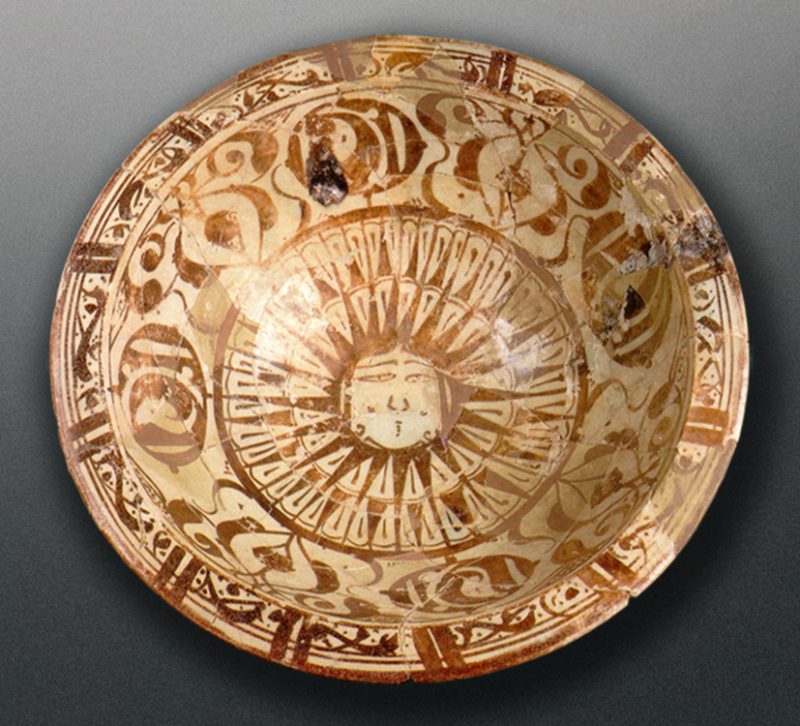
Ceramic bowl with a sun motif
Description
A large dark-brown lustre bowl from Qal’at Ja’bar, which is a particularly remarkable example of so-called Raqqa-ware. It was uncovered in the 1973/4 archaeological excavations by the Syrian Directorate of Antiquities within the medieval fortress of Qal’at Ja’bar on the left bank of the Middle Euphrates, thus making it one of the few pieces that reached the Museum not via the art market but from a particular archaeological site.
The decoration of this piece is highly original: it is dominated by an impressive sun with a female face, almond-shaped eyes, beauty marks on the cheeks and loosely curled hair. The solar-shaped face is framed by two halos of radiating rays which cover the central surface of the bowl.
The astrological sign of the sun is a common iconographic motif on contemporary metalwork where it is usually surrounded by the planets and signs of the zodiac forming a cosmic circle. On medieval Syrian pottery, however, such a depiction is unique. Interestingly enough, the potter replaced the circle of planets with eight medallion-like ornaments – alternating red-on-white vegetal motifs with white-on-red lunar cartouches. This must be a specific “Raqqa” variation on the metalwork theme. The rim of the bowl is freely painted with dotted and curvilinear motifs that are regularly punctuated by a pair of vertical lines, a feature echoing calligraphic decoration.
The dish belongs to the rare group of lustre-painted pieces with figurative decoration. Its shallow shape with convex profile, flat, everted rim and flaring foot is standard and particularly popular with lustre-wares. Its exterior is undecorated. The greenish transparent glaze covers only the top two-thirds of the vessel in typical Raqqa manner.


Leave A Comment