
The animal-shaped weights of Ugarit
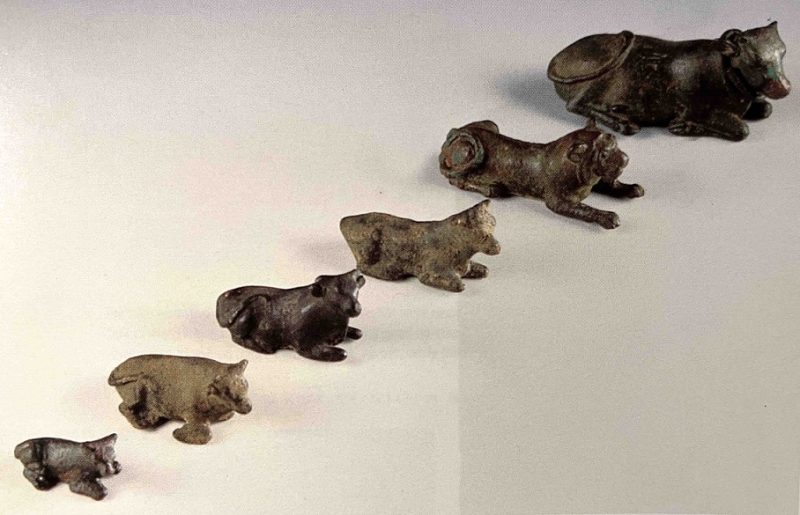
Description
The bronze weights discovered in Ugarit, now housed in the National Museum of Aleppo, stand as a vivid testament to the economic and commercial advancements of this flourishing coastal city in the late second millennium BCE. Ugarit was renowned for its sophisticated industry and distinctive artistic style, which is evident in the intricate details of the various bronze weights crafted with exceptional precision.
These weights, often shaped like animals, were common in the ancient Near East, but Ugarit distinguished itself with a remarkable diversity in this category. Among the 575 weights unearthed in the city, approximately 60 are made of metal, with about half taking the form of animals such as frogs, lions, rams, and cows. It is rare to encounter a complete set like this, which includes six bronze weights skillfully designed in small, medium, and large sizes. These pieces featured hollow bases filled with molten lead, sealed with bronze plugs that concealed the openings.
Standards and Forms of Measurement:
The people of Ugarit employed several weight standards within a precise measurement system based on the “mina” (𐎎𐎐), a unit divided into 50 shekels (kbd in Ugaritic). One shekel was equivalent to approximately 9.4 grams by modern standards. The mina, which could be subdivided into smaller units like halves and quarters, weighed about 470 grams. These weights were crucial for measuring precious metals, spices, and foodstuffs. Notably, the weight system used in Ugarit was connected to standards used in Egypt and Babylon, regions that maintained active trade relations with Ugarit.
In addition to these six small weights measured in minas and shekels, Ugaritic texts reveal larger weight units such as the “talent” (kikar in Ugaritic, equivalent to 60 minas or 3000 shekels, approximately 28.2 kilograms), which was the maximum weight measure used in the city.
For instance, a Ugaritic document discovered in 1937 indicates that three bales of wool intended for purple dyeing weighed “eight talents and 1200 shekels,” equivalent to about 236 kilograms of raw wool. This substantial quantity reflects the advanced level of production and the significance of this product to Ugarit. It raises questions about how much of it was destined for local consumption and how much for export.
Another document details transactions between 29 sellers from Ugarit and a major merchant, with the weights of purple-dyed wool purchased by the merchants ranging from 100 to 400 shekels each, totaling about 66 kilograms.
Yet another document mentions a gift from the king of Ugarit to his Hittite neighbor, consisting of fifteen two-colored purple wool shirts, with a total weight of 7800 shekels, or about 75 kilograms. This amount surpasses the total sold by the 29 merchants in the previous example.
The ancient measurement units in Ugarit, with their complexities and the ability to be subdivided into smaller units, underscore the sophistication of daily commercial life in the city. This reflects a model of economic activity prevalent across the ancient Near East. This precise system was not merely a calculative tool but a necessity for a complex economy dealing with goods of varying values, from foodstuffs to precious metals and spices. The figures in the texts also illuminate the relative importance of these goods, providing a clear picture of the priorities and economic lifestyle of ancient societies.



Leave A Comment