Description
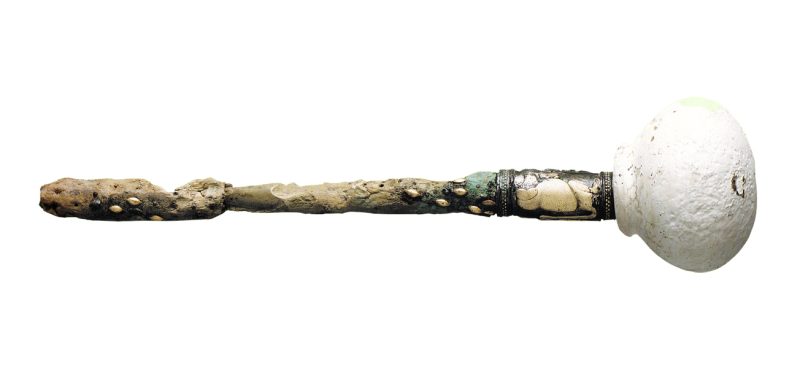
The polished white limestone mace and the handle fragments of gold and precious materials may have been part of the same ceremonial object. They were found in pieces on the floor of the Tomb of the Lord of the Goats, the richest burial chamber of the royal palace at Ebla. This exquisitely made object is certainly of Egyptian origin. The ivory part of the handle is decorated with small oval silver and gold ornaments, but the really sensational feature is the carefully executed metallic section: applied to a silver base, gold monkeys with raised paws worship a row of gold hieroglyphs which form the personal name Hetepibre. This name belonged to an obscure pharaoh of the Thirteenth Dynasty, Hornedjheryotef, who reigned from 1775 to 1765 B.C.
It is astonishing to find an Egyptian pharaonic object from a dynasty of little importance in the tomb of an Eblaite lord. How did it get there? Was it part of the spoils of battle, or was it given to the nobleman by the Egyptian sovereign? We cannot answer these questions, but it is evident that the owner of the mace had had it for a long time. The hieroglyphs had fallen off and were reattached by an Eblaite artisan, who obviously know nothing of the Egyptian language, for he put the sign htp in the wrong place. This error is of historical importance, since it helps us date the tomb.





Leave A Comment