
Statue of Martama of Hieropolis
Description
This remarkable funerary sculpture of Martama stands as a powerful testament to the artistic traditions and burial customs that flourished in Syria during the Syrian-Hellenistic era.
A Masterpiece of Artistic Expression
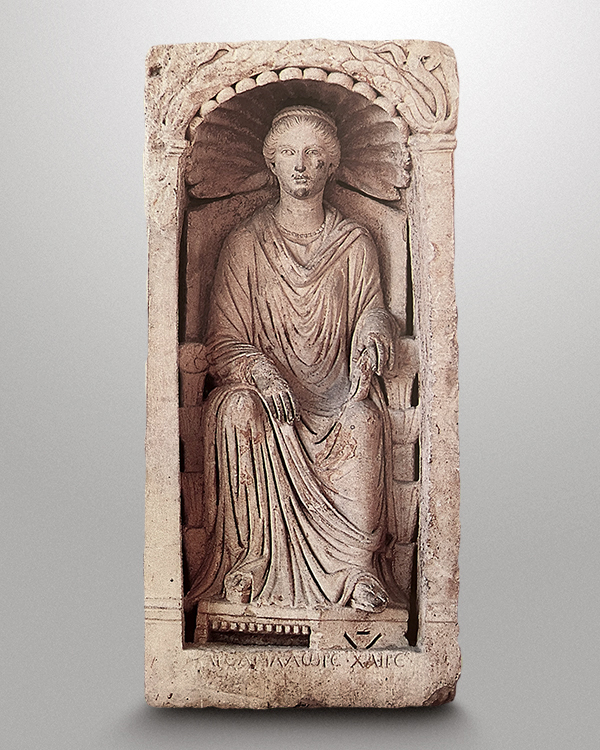
Martama is depicted seated in an armed chair gracefully within an elegant niche, dressed in a flowing, full-length robe that drapes softly around her form—an authentic reflection of the fashion of her time. Around her neck rests a delicate necklace, while finely braided bracelets adorn her wrists, blending simplicity with refined elegance. In her left hand, intricate detailing reveals a ring on her little finger, and upon her head sits a dignified headdress that adds to her noble presence.
Every artistic choice speaks of craftsmanship and care: the finely carved arms and back of the chair, the subtle suggestion of her feet beneath the long garment, and the meticulous attention to facial features all highlight the realism and emotional depth characteristic of funerary art from this period. This statue is not merely a likeness—it is a celebration of identity, status, and memory.
An Inscription of Grief and Honor
At the base of the monument, an inscription in Greek reads:
“Martama, mourned for her youth.”
These few words carry profound emotion—a personal lament for a life cut short. They transform the statue from a work of art into a story: the story of a beloved woman, respected in life and honored in death. The epitaph reflects a deep cultural desire to preserve the memory of the departed with dignity and beauty.
A Fusion of Cultures in Stone
Martama’s statue embodies a unique synthesis—local Syrian traditions interwoven with Hellenistic artistic influences. The symbolism, attire, and inscriptions reflect a society deeply committed to honoring the dead through expressive art that bridges the physical and spiritual realms. It is a reminder of how ancient communities used sculpture not only to mourn, but to immortalize.


Leave A Comment