
Commemorative Sculpture of a Man from Manbij (Hierapolis)
Description
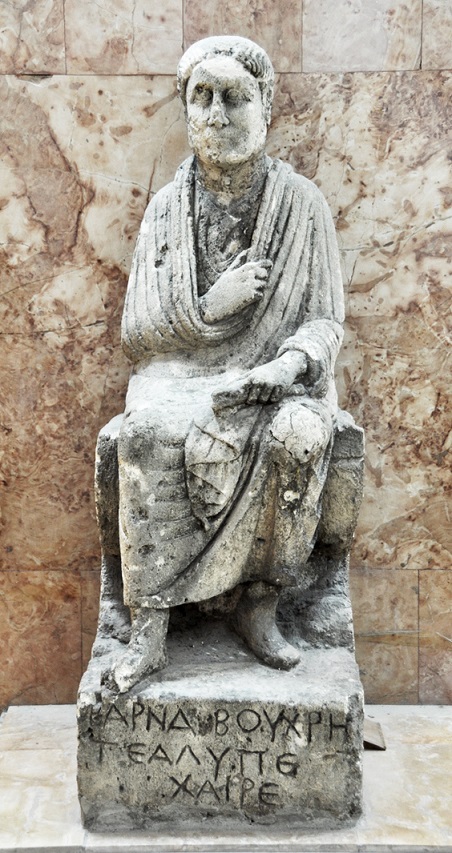
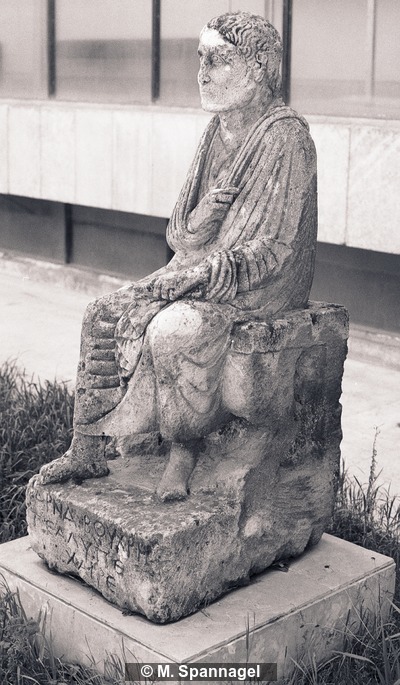
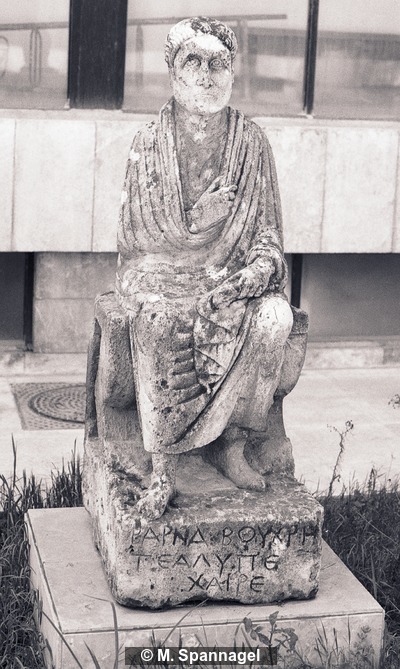
This commemorative statue represents a significant example of local sculptural production in the city of Manbij during the Classical period. The figure is shown seated in a formal pose on a simple chair, wearing a toga-like garment that envelops the body, with carefully rendered folds and fluid drapery. The right hand grasps the edge of the garment, while the left rests on the knee—a pose commonly associated with funerary and commemorative sculpture emphasizing dignity and social status.
The stylistic features—hair arrangement, calm facial expression, and seated posture—place the work within the late Classical sculptural traditions of northern Syria. While the treatment of the figure and drapery reflects clear Roman influence, the proportions and expression retain a distinctly local character.
The Greek inscription carved on the base confirms the commemorative nature of the piece, indicating that the statue was erected in honor of an individual named “Barnabos,” reinforcing its interpretation as a funerary or memorial monument for a person of notable social standing.
Greek Inscription
BAPNABOY XPH
TEΛΛΥ ΠE
XAIPƐ
Translation (as provided in the source):
“Barnabos the great, greetings.”
Archival records indicate that this statue, together with another statue of a woman named “Marta,” was illicitly removed from the Manbij region during the 1960s. Both pieces were intercepted by customs authorities during an attempted export and subsequently transferred to the National Museum of Aleppo. There, they underwent study, documentation, and restoration, and were incorporated into the museum’s collection as key examples of local Classical-period sculpture from Manbij.
This statue also offers a broader anthropological perspective on the role of commemorative sculpture in expressing social identity and personal memory, functioning not only as a visual representation but as a symbolic medium reinforcing status and perpetuating the presence of the individual within public or funerary space.




Leave A Comment