Description
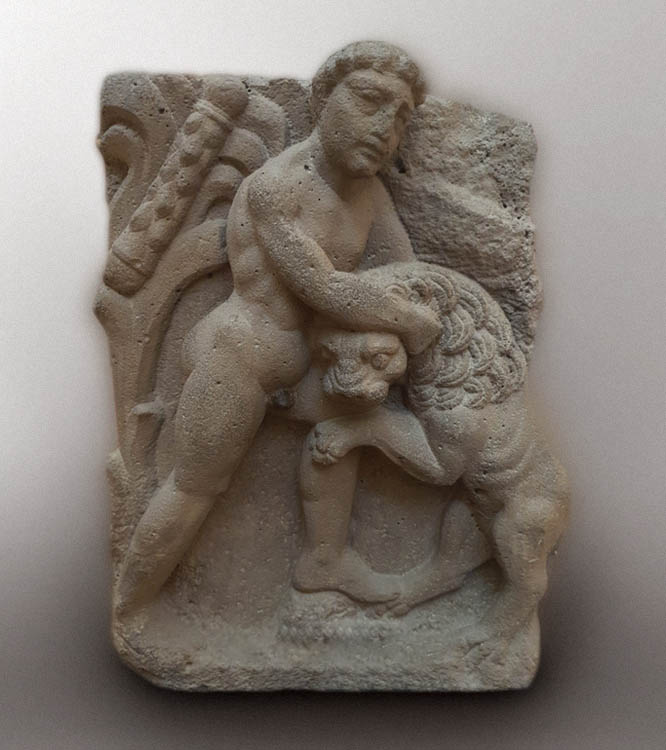
This relief captures the intense moment of Herakles wrestling the infamous Nemean Lion, a beast from Greek mythology known for its golden fur that was impervious to weapons. The scene shows a youthful, nude, and beardless Herakles on the left side, clutching the lion in a powerful headlock under his left arm. The lion, in an attempt to escape, presses its head against Herakles’ waist, biting the thigh of his bent leg, while its forepaw is extended in desperation. The artist skillfully captures the creature’s final moments, indicated by the lion’s closed eyes, shown with a delicate incised line.
The slab has minor damages; the upper and right edges are broken, and Herakles’ facial features and genital area show signs of wear. However, the piece remains largely intact, covered with a thin, opalescent brown patina. The background behind Herakles and above the lion is textured with chisel marks, while the lion’s mane is stylized in sickle-shaped tufts. Herakles’ body reflects the fleshy anatomy of young men, yet his maturity is subtly indicated by pubic hair, detailed with an incised line above the genital area. His short hair frames his face in buckle-shaped strands that cover his ears. Despite the scene’s tension, Herakles’ face is calm, with a serene expression not quite fitting the struggle depicted.
To the left of Herakles, a plant resembling a stone palm with cut branches is shown. This plant serves as a hanger for his knobby club, a weapon useless in close combat but still symbolic of his might.
Mythological Background
The Nemean Lion, known in Greek mythology as Νεμέος λέων (Neméos léōn), was a formidable beast that terrorized the hills of Nemea. Different myths recount the lion’s origins: Hesiod states it was born from Orthus and an unspecified mother, potentially the Chimera or Echidna. Another legend claims the lion was a creation of the moon goddess Selene, who cast it from the heavens at the request of Hera. Apollodorus describes it as the offspring of Typhon, while Photius connects it to the dragon Ladon, guardian of the golden apples, as a sibling.
King Eurystheus, Herakles’ cousin, set his first labor as slaying the Nemean Lion. The lion, impervious to mortal weapons due to its magical fur, was a challenging opponent. Herakles tracked it down in the town of Cleonae and cornered it in a cave with two entrances. Blocking one exit, Herakles entered the other and, in the dim light of the cave, stunned the lion with his club before ultimately strangling it with his bare hands.
Upon killing the lion, Herakles donned its impervious pelt as armor. This hide became a symbol of his strength, representing both his success in this impossible task and the protection it granted him in future battles. While most accounts attribute his armor to the Nemean Lion, some traditions suggest it was from the Lion of Cithaeron.
This relief encapsulates Herakles’ legendary feat, immortalizing the hero’s struggle against a seemingly invincible foe and reflecting the enduring legacy of his labors in Greek mythology.

Heracles slaying the Nemean lion. Detail of a Roman mosaic from Llíria (Spain). (Source : Wilipidia)









Leave A Comment