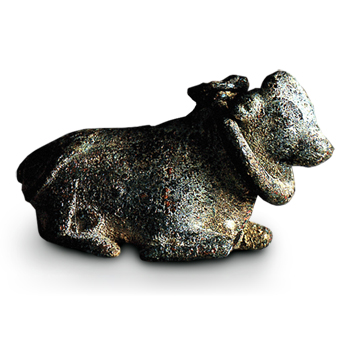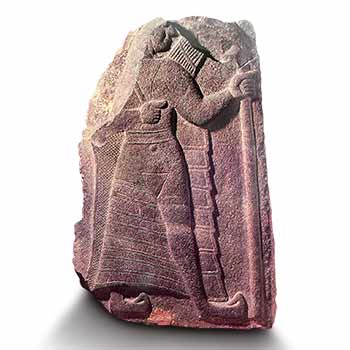
Lion sculpture

A large copper sculpture of a lion with a powerful body, stylized mane, and open mouth, depicted in a static, frontal pose, symbolizing strength and divine protection.

Description

Two lion statues made of copper were found in 1936 by André Parrot at the “Temple of Lions” in Mari. The “Temple of Lions”  is known to have been built by the Shakkanakku governor of Mari named Ishtup-Ilum circa 2150 BCE.   One of the two lion statues (the above display) is in Aleppo museum, while the other is currently on display in the Near Eastern Antiquities Department of the Louvre, the later statue is damaged, having been crushed during the destruction of the site, and only the anterior part of the body remains.

- The National Museum of Aleppo – متحف حلب الوطني

The original statue at Aleppo museum to the left upon discovery (**) Achieve; the French archaeological mission.

The Lion of Mari was probably produced to serve as Protome in the early Second Millennium BCE, at a time when the temple was being rebuilt, presumably during the reign of Zimrī-Lim. It was excavated in 1936 by the Parrot expedition at the Temple of Dagon in Mari (now Tell Hariri, Syria)

  • Site: TELL HARIRI, ANCIENT MARI: TEMPLE OF THE LIONS (Temple of Dagan)

  • Date: 1800 BC

  • Material: Copper

  • Item Dimensions: 70 x 54 x 40 cm 

  • Archaeological Mission:

  • National Museum Of Aleppo (2011) – NATIONAL MUSEUM, ALEPPO M 7906 SMC 132B

  • VMS Code: Alp 037

Excavation Site Location

Your Content Goes Here

(**) Image credits Patrimoine du Proche-Orient https://archeologie.culture.gouv.fr

Not every record you will find here is complete. More information is available for some works than for others, and some entries have been updated more recently. Records are frequently reviewed and revised, We welcome any additional information you might have.

Record Completion 70%