
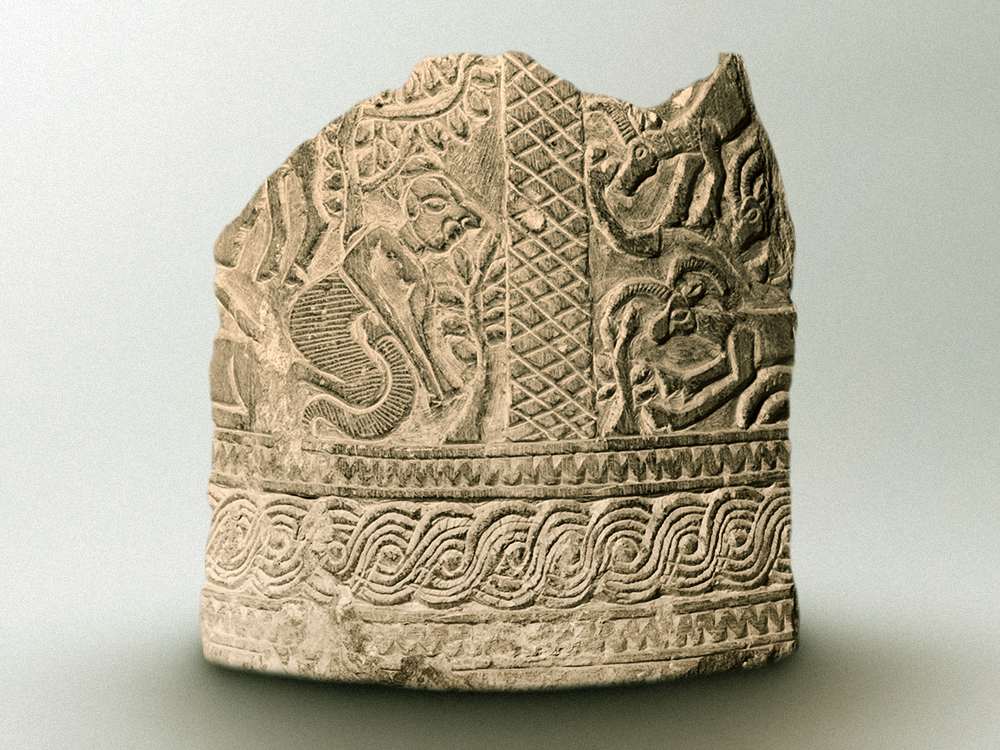
Decorative panel depicting a man harvesting a seedling from a palm tree
Description
An Ancient Agricultural Scene from Mari: A Testimony to Advanced Techniques
This article examines a rare artifact from Mari (modern-day Tell Hariri), a prominent city-state on the Euphrates, dating back to the mid-3rd millennium BCE. The piece captures a compelling scene of a man harvesting a young date palm offshoot—a practice central to agriculture in ancient Mesopotamia and crucial to the economic and cultural life of the region. The artifact sheds light on advanced agricultural methods and their symbolic integration into the art of the period.
The Depiction of Agricultural Innovation
The artifact highlights a specific process known as “offshoot propagation,” an ancient method of asexual plant reproduction. Farmers would carefully separate offshoots, or “suckers,” from the parent palm tree. This technique ensured that the new tree produced fruit identical in quality to the original, guaranteeing uniformity in the crop. Additionally, it significantly reduced the time needed for the tree to bear fruit, providing yields two to three years earlier than those grown from seeds.
The carving vividly portrays the farmer bending to extract the young palm shoot with precision, evoking the labor-intensive yet skillful practices that sustained ancient agricultural economies.
Symbolic and Artistic Elements
The artifact is not merely functional; its design incorporates meaningful motifs. Beneath the main scene is an intricately carved band resembling braided hair. This design likely symbolizes water channels or irrigation systems, which were indispensable for agriculture in Mari. The interplay of practical agricultural imagery and symbolic elements demonstrates the sophisticated cultural context of the artifact, where art and daily life were deeply intertwined.
Mari as a Center of Innovation
Mari was renowned as a hub of agriculture and trade in the ancient Near East. Its economy relied heavily on advanced irrigation techniques and the cultivation of crops such as dates, which were vital for local consumption and export. The texts recovered from Mari’s archives confirm the city’s role as a major supplier of agricultural products to distant regions. The artifact complements these textual records, offering a tangible representation of the city’s agricultural achievements.
Historical Significance
This artifact serves as a unique historical document that goes beyond illustrating a routine activity. It highlights the ingenuity of ancient farmers in developing sustainable practices to maximize their resources. Furthermore, it reflects the importance of date palms not only as a vital economic resource but also as a cultural and artistic motif.
The discovery underscores Mari’s status as a leading agricultural and cultural center in antiquity and calls for continued exploration of such artifacts. These findings deepen our understanding of the ingenuity and resilience of early civilizations and their ability to integrate practical knowledge into their cultural and artistic expressions.


Leave A Comment