Wagon (Kids Toy)

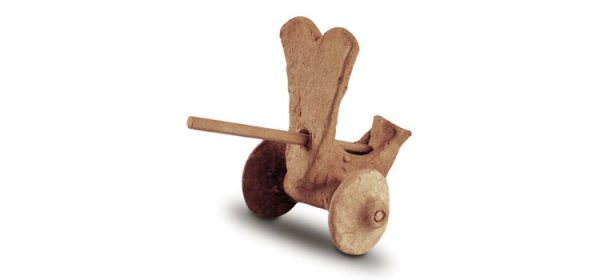
Terracotta wagon toy, 10 x 8 x 5 cm, model of a two-wheeled cart. Excavated at Tell Chuera, Syria, c.2500 BC. National Museum of Damascus, inv. DAMASCUS 196.

Description

Carts were developed towards the end of the fourth millennium. At first, they were drawn by asses or oxen, which were preferable for transporting heavy loads. The two-wheeled model is called a cart. The merchandise carried in four-wheeled wagons was protected with a cover. These wagons were pulled by four animals attached to either side of the pole that projected from the main body. As a means of transportation, wagons were slow, going no more than 15 kilometers per day, and could be used only on fairly flat land. Because of these disadvantages, it was more profitable to transport goods on the backs of asses, since these animals could travel over uneven terrain and cover a distance of 20 kilometers in a day. However, their loads had to be distributed in bags on either side of their spine, since the saddle pack for carrying goods directly on an animal’s back was not invented until a little before our era. 
  • Site: TELL CHUERA

  • Date: 2500 BC

  • Material: Terra Cotta

  • Item Dimensions: 10 x 8 x 5 cm

  • Archaeological Mission:

  • National Museum Of Damascus (2011) – Museum Number: DAMASCUS 196

  • VMS Code: Dam 081-2

Excavation Site Location

  • Meyer, Jan-Waalke, and Emmanuelle Vila. “Excavation of Tell Chuera in Syria: An Archaeological History.” ArchéOrient—Le Blog, February 26, 2021. https://archeorient.hypotheses.org/15787.
  • Tamm, Alexander. Tell Chuēra: Palast F—Architektur, Stratigraphie und Kleinfunde. Vorderasiatische Forschungen der Max Freiherr von Oppenheim-Stiftung 2,7. Wiesbaden: Harrassowitz Verlag, 2018.

Your Content Goes Here

Your Content Goes Here

Not every record you will find here is complete. More information is available for some works than for others, and some entries have been updated more recently. Records are frequently reviewed and revised, We welcome any additional information you might have.

Record Completion 70%