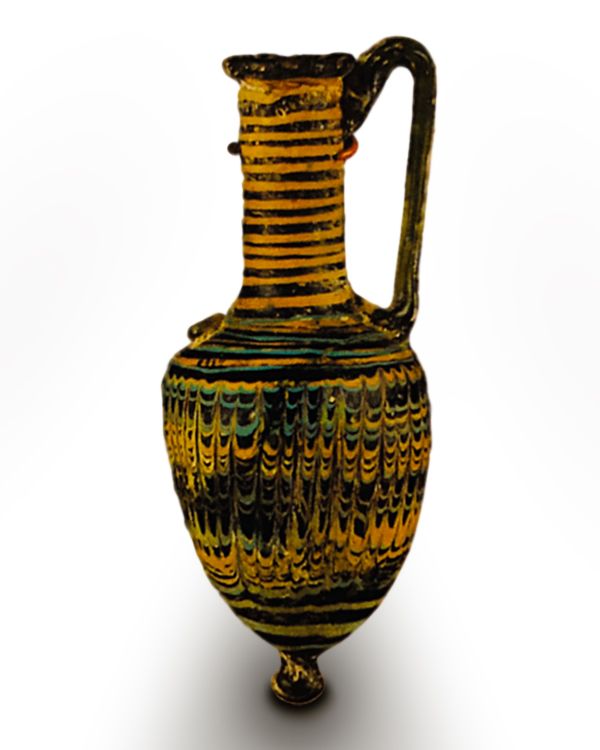
Flask with a handle

Glass flask, 15 x 6 cm, Syria, ca. 800 BC. Early vessel for perfumes and oils. National Museum of Damascus, inv. 13732/5949, Dam 02-3.

Description

This flask is a fine example of the earliest tradition of glassmaking, commonly called core-formed glass. The technique consisted of winding heated glass threads around a removable core of clay and organic material, which was later scraped out. Such small vessels, typically under 20 cm, were used to hold perfumes, oils, and other costly liquids. Syria was one of the first centers of glass production, with some ancient authors attributing the invention of glass vessels to Syrian craftsmen. This piece (15 × 6 cm) embodies both the technological experimentation of early artisans and the prestige of glass as a luxury material in the first millennium BC.
  • Site: UNKNOWN

  • Date:  800 BC

  • Material: Glass

  • Item Dimensions: 15 x 6 cm/

  • Technique/Style of Manufacture: Early glassmaking, core-formed glass (flask created by winding molten glass threads around a core)

  • Function: Container for perfumes/oils

  • Condition: Preserved; signs of wear

  • Archaeological Mission:

  • National Museum Of Damascus (2011) – DAMASCUS 13732/5949

  • VMS Code: Dam.02-2

Excavation Site Location

  • Harden, Donald B., Hansgerd Hellenkemper, Kenneth Painter, and David Whitehouse. Glass of the Caesars. Milan: Olivetti, 1987.
  • Pliny the Elder. The Natural History. Vol. 6. Translated by John Bostock and H. T. Riley. London: Henry G. Bohn, 1857, bk. 36. Perseus Digital Library.

Your Content Goes Here

Your Content Goes Here

Your Content Goes Here

Not every record you will find here is complete. More information is available for some works than for others, and some entries have been updated more recently. Records are frequently reviewed and revised, We welcome any additional information you might have.

Record Completion 70%