Votive Relief With Heracles And Other Palmyrene Gods

- The national museum of Damascus – متحف دمشق الوطني

Description

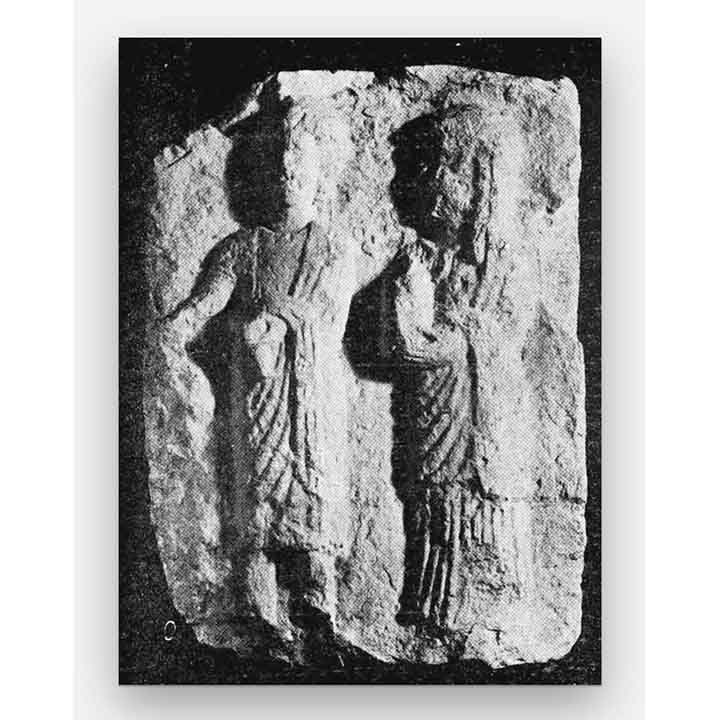
This unfinished relief was reused in antiquity and found built into the wall of a well under the Bel Temple in Palmyra. It depicts four standing deities. Heracles is at the left, easily recognized by his attributes, a lion skin and a club; perhaps he represents Nergal, the equivalent of Heracles in ancient Near Eastern mythology. Next to him stands an unidentified female deity with a halo around her head. Several suggestions as to her identity have been put forward: Venus, Belti, Astarte, Herta, Nanai. She is followed by two male deities with curly hair, halos, and palm branches in their right hands. The god to the left with a large crescent moon resting on top of his head is Aglibol, the one to the right probably Yarhibol, the sun god. Originally the relief may have continued to the right, where one would expect Bel, the ancient Baal, the main deity of Palmyra, and possibly, as in other reliefs, “the founder” 

On aesthetic grounds this relief belongs to the provincial Palmyrene style in its most archaic Hellenistic phase. The upper bodies and heads of all four figures are presented strictly en face. The finely modeled faces with their expressive large eyes and carefully stylized coiffures and beards sharply contrast with the sketchy carving of the clothes.

  • Excavated from: Palmyra, Bel Temple

  • Date: 100-1 B.C. 

  • Material: Yellowish limestone

  • Item Dimensions: Height: 22.5 cm; width: 35 cm

  • Archaeological Mission:

  • National Museum Of Damascus (2011) – Museum No.: Damascus 4242/10050 

  • Index code Dam 055-3

Excavation Site Location

  • Colledge, Malcolm A. R. The Art of Palmyra. Studies in Ancient Art and Archaeology. London: Thames and Hudson, 1976, p. 45, fig. 36.
  • Drijvers, H. J. W. The Religion of Palmyra. Iconography of Religions, Section XV: Mesopotamia and the Near East 15. Leiden: E. J. Brill, 1976, pp. 12, 25, pl. 14.
  • du Mesnil du Buisson, Robert. Les tessères et les monnaies de Palmyre: Un art, une culture et une philosophie grecs dans les moules d’une cité et d’une religion sémitiques. Paris: E. de Boccard, 1962, p. 209, fig. 140.
  • Gawlikowski, Michał. “Un nouveau type d’Héraclès à Palmyre.” Études et Travaux 3 (1966): 142–149, p. 149, fig. 3.
  • Łukasiak, Ewa. “Ikonografia Yarhibola.” Studia Palmyreńskie 5 (1974): 1–44, p. 17, fig. 9.
  • Morehart, Mary. “Early Sculpture at Palmyra.” Berytus 12 (1956–1957): 52–83, p. 59, no. 10, fig. 10.
  • Seyrig, Henri. Antiquités syriennes. Quatrième série. Paris: Librairie orientaliste Paul Geuthner, 1953, pp. 1, 18, pl. 1.
  • Seyrig, Henri. “Héraclès-Nergal.” Syria 24, nos. 1–2 (1944–1945): 62–80, pp. 62, 79, no. 1, pl. 1.
  • Seyrig, Henri. “Les dieux armés et les Arabes en Syrie.” Syria 47, nos. 1–2 (1970): 77–112, p. 107, fig. 28.
  • Teixidor, Javier. The Pantheon of Palmyra. Études préliminaires aux religions orientales dans l’Empire romain 79. Leiden: E. J. Brill, 1979, pp. 113, 136, pl. 31:2.

Your Content Goes Here

Your Content Goes Here

Not every record you will find here is complete. More information is available for some works than for others, and some entries have been updated more recently. Records are frequently reviewed and revised, We welcome any additional information you might have.

Record Completion 70%