
Helmet with mask Silver and iron

Description
The Helmet of Homs stands as one of the most prominent archaeological artifacts, encapsulating a rich history that reflects the high level of craftsmanship achieved by Syrian artisans during the first century AD. This unique masterpiece was discovered in 1936, following a theft carried out by artifact looters at the site of Tell Abu Sabeen, which housed a royal cemetery located west of the city of Homs. Despite this, thanks to the efforts of the Syrian Directorate of Antiquities, authorities were able to recover this valuable piece and incorporate it into the national collection of antiquities. Through this research, we will explore the story of this rare artifact, from its discovery to the details of its creation and potential uses, drawing on several scholarly reports that have examined the piece. Among the most notable of these is the report authored by Professor Henry Seyring, published in the Syrian Archaeological Annals in 1952.
The Royal Cemetery of Homs
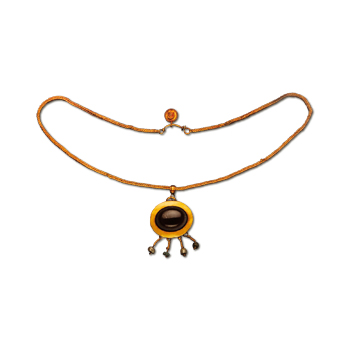
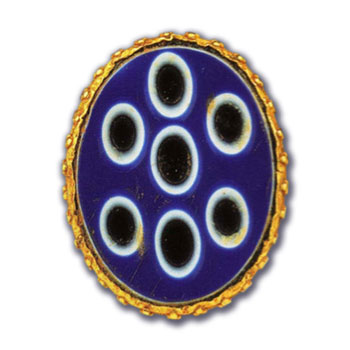
The Royal Cemetery of Homs is situated in the ancient city of Homs, formerly known as Emesa. The royal cemetery was discovered at Tell Abu Sabeen, an archaeological site located west of modern-day Homs. Excavations began in 1936 under the direction of both Henry Seyring, Prince Jaafar Abdul Qader Al-Husseini (1895-1970), and Daniel Schlumberger, prior to the removal of the tell to make way for the construction of the municipal stadium now known as Khalid ibn al-Walid Stadium. The cemetery contained 22 royal tombs belonging to the ruling family of Emesa, who governed the region during the first centuries before and after Christ. These tombs housed invaluable funerary treasures, including gold jewelry, ornate weapons, pottery, ceremonial masks, and notably, the famous helmet known as the Helmet of Emesa, which was found in Tomb No. 1.
The Shrine of Shamsigeram: A Lost Monument
The Shrine of Shamsigeram was one of the most prominent archaeological landmarks within the Royal Cemetery of Homs. It is believed that the shrine was constructed in either 78 or 79 AD by Gaius Julius Sampsigeramus, a member of the royal family of Emesa. The shrine was a massive memorial tomb, standing approximately 25 meters above ground, distinguished by its unique architectural design that blended Roman and Eastern influences. Unfortunately, the shrine was destroyed in 1911 by Ottoman authorities, who used dynamite to clear the site for the construction of an oil depot. Nevertheless, some drawings and historical descriptions of the shrine remain. In the 18th century, Richard Pococke described the monument as being located west of the old city of Homs near the present-day train station. However, much credit is owed today to the French researcher and traveler Louis-François Cassas (1756-1827), who meticulously documented and illustrated the Shrine of Shamsigeram. Cassas’ detailed drawings are now considered the primary visual sources depicting the form of the shrine. His works were published in the book Picturesque Journey of Syria , released in 1799, which included paintings and illustrations of numerous archaeological sites in Syria, including the aforementioned shrine.
The Discovery
The helmet was discovered by artifact looters in August 1936. During their unauthorized excavation near the former site of the Shamsigeram Memorial, the looters stumbled upon a complex of royal tombs belonging to the kings of Homs from the lineage of Shamsigeram the First, subsequently plundering most of the buried funerary artifacts. By chance, some small gold flakes that had covered the shrouds during the theft scattered and fell at the site while the looting took place. On the morning of the following day, some children noticed the presence of these gold flakes and took them to the market. The matter drew the attention of the police, who promptly alerted the archaeological authorities, specifically Prince Jaafar Al-Husseini. An operation ensued to track down and arrest the looters, confiscate what they had stolen from the royal tombs, and deposit all the recovered artifacts, including the helmet, into the National Museum’s collection in Damascus.
This incident sparked widespread interest on both academic and public levels, prompting some antique dealers to exploit the situation for their own benefit. They forged replicas of the discoveries and falsely claimed that these items originated from the royal tombs of Emesa. However, the swift intervention of Prince Jaafar Abdul Qader, who led a meticulous investigation into the discovery, prevented the spread of these counterfeit pieces. Additionally, his efforts expanded the scope of research and excavation at the royal burial site, with contributions from the French archaeologists Daniel Schlumberger and Henry Seyring.
The tomb where the helmet was found—designated as Tomb No. 1—was one of 22 tombs within the royal cemetery complex. It consisted of two underground chambers, one atop the other. The lower chamber served as the burial site, featuring rocky walls and an earthen floor measuring 2.2 meters in length, 1.25 meters in width, and 1.72 meters in depth. Additionally, between five and seven basalt beams were placed over the opening connecting the lower chamber to the upper section, which was then filled with soil up to ground level.

Syrie, Homs, Tell Abou Saboun 9×14 cm, gelatin film plan. Tomb 14 of the necropolis. (Wikipedia)
Description of the Artifact
The helmet was entirely crafted from iron and coated with a layer of silver, consisting of two main sections. The upper section comprises a head covering bearing traces of fabric threads that once enveloped it, encircled by a wreath resembling small laurel leaves. Following this is a neck guard at the back (the nape) adorned with intricate botanical motifs executed with precision and artistry. The second, frontal section features a face mask, carefully designed by its maker to reflect the true features of its owner, including the shaping of the nose, eyelids, eyes, eyebrows, and extending to the auricles. The neck guard, covered by a decorated plate, extends outward to protect the shoulders. The upper part is bordered by a garland of gilded ivy leaves, with a smooth extension flowing into the neck cavity. Beneath this neck guard lies a twisted, ornamented cord made of thorn branches, embellished with engravings of birds and butterflies in gold leaf. This combination of silver, gold, and iron components gives the helmet its multicolored appearance.
Returning to the face mask, it was crafted from iron plated with silver leaf. The primary hinge from which it hangs consists of three parts: an iron tube attached to the inner headpiece alongside an outer silver tube, a slotted silver tube fixed to the face mask that covers the initial part, and a pin passing through both tubes, each end equipped with a silver handle. Notably, openings were also created between the lips, as well as for the nose and below each eye, to allow for a broader field of vision. The mask’s thickness measures approximately 2 mm, in addition to the silver layer, which ranges from a quarter to half a millimeter in thickness.
Significance of the Artifact
The Helmet of Emesa is considered the oldest known Roman helmet with a face mask. Its distinctive characteristics suggest that the craftsman attempted to translate certain individual traits of the wearer’s face onto the helmet, taking care to consider the facial features of its owner during execution. This grants the helmet exceptional artistic and unique qualities. It is likely that the helmet was crafted for use during military parades and battles, as it is thick and heavy, providing protection against powerful blows or war arrows. Evidence supporting this includes the observation that a strong impact caused the hole present in the head covering. Furthermore, the unusually narrow eye openings also indicate a deliberate effort to maximize protection.
Status of the Helmet’s Owner
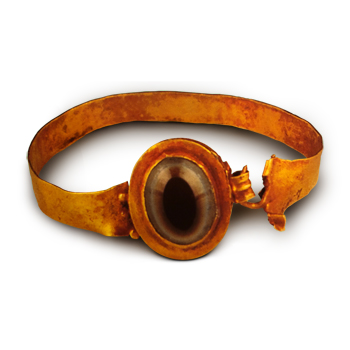
It is evident that the owner of this helmet held a high social, military, and political rank, potentially belonging to one of the kings of Homs or a renowned military commander. This assumption is supported by the presence of two golden rings discovered in the same tomb, one of which bears a half-length portrait of a king wearing earrings, rendered with Eastern artistic features.
Exhibition
The artifact was not in optimal condition when it was discovered, as time and rust had taken their toll. Consequently, it was sent shortly thereafter to the British Museum’s laboratories for restoration. The helmet was displayed at the King Edward Exhibition in the British Museum on loan for a month, beginning April 25, 1955, before being returned to Damascus. From 1999 to 2002, the helmet was part of a traveling exhibition titled “Syria: Land of Civilizations,” which visited Switzerland, Canada, and the United States. At the time, the Helmet of Homs featured prominently as the exhibition’s main image and graced the cover of the accompanying catalog.

Profile view of Helmet with mask Silver and iron -Tell Abu Saboun (*)
The Helmet of Homs is regarded as one of the most significant archaeological artifacts, reflecting the skill and artistry achieved by Syrian craftsmen during the first century AD. Although artifact looters were responsible for its discovery, the efforts of the Syrian Directorate of Antiquities ensured its recovery and incorporation into the national antiquities collection. Today, the helmet remains preserved in the Museum of Damascus after nearly two millennia, serving as a testament to the achievements of all Syrians and exemplifying the richness of their historical and cultural heritage.
As part of the Virtual Museum of Syria project, we are working on dedicating a special section to the collection of artifacts discovered in the area of the royal tombs of Homs. This initiative aims to highlight these unique pieces and provide the global community with the opportunity to explore the details of this collection. The project is currently underway, and we strive to make it a part of our ongoing efforts to preserve and promote Syrian archaeological heritage in an innovative and sustainable manner for future generations.








Leave A Comment