Vessel in the form of a pig

- The National Museum of Aleppo – متحف حلب الوطني

Description

In Syria, the pig was domesticated at the same time as cattle, in about 7000 BC, when goat and sheep raising was already well established. Wild pigs lived in marshy regions receiving more than 300 millimeters of rain each year and in wooded areas. Hog raising spread quickly, since the pig is the fastest-breeding domestic animal and represents an important source of protein. However, as the Near East was deforested and complex societies developed, pork consumption diminished. With the introduction of religious precepts prohibiting pork, people stopped eating it altogether.
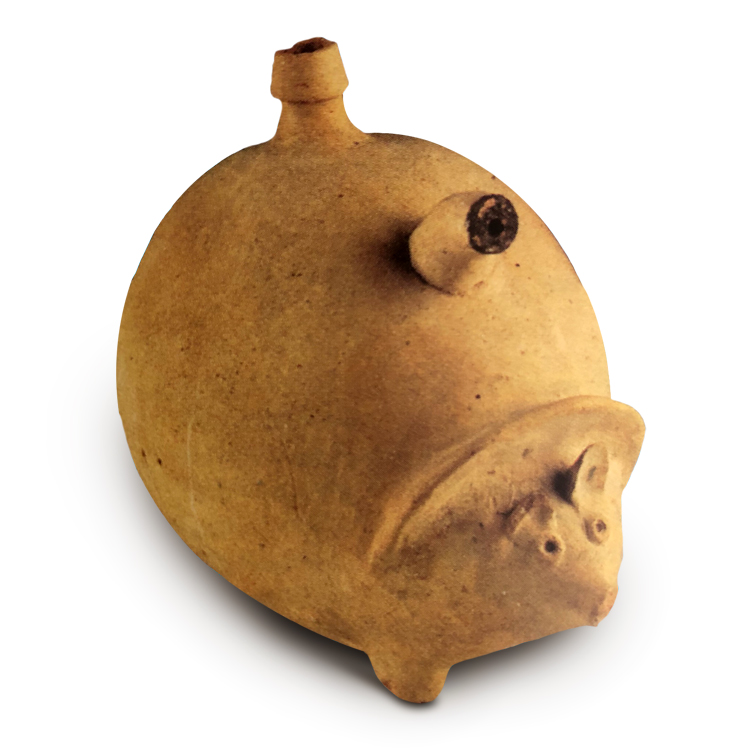
  • Site: JEBEL ARUDA

  • Date: 3200 BC

  • Material: Terra cotta

  • Item Dimensions: 30 x 25 cm

  • Archaeological Mission:

  • National Museum Of Aleppo (2011) – ALEPPO M 10167

  • VMS Code: Alp 080

Excavation Site Location

  • Albarella, Umberto, Mauro Rizzetto, Hannah Russ, Kim Vickers, and Sarah Viner-Daniels, eds. The Oxford Handbook of Zooarchaeology. Oxford: Oxford University Press, 2017.
  • Larson, Greger, Keith Dobney, Umberto Albarella, Meiying Fang, Elizabeth Matisoo-Smith, Judith Robins, Stewart Lowden, Heather Finlayson, Tina Brand, Eske Willerslev, Peter Rowley-Conwy, Leif Andersson, and Alan Cooper. “Worldwide Phylogeography of Wild Boar Reveals Multiple Centers of Pig Domestication.” Science 307, no. 5715 (2005): 1618–1621. https://doi.org/10.1126/science.1106927

Your Content Goes Here

Your Content Goes Here

Your Content Goes Here

Not every record you will find here is complete. More information is available for some works than for others, and some entries have been updated more recently. Records are frequently reviewed and revised, We welcome any additional information you might have.

Record Completion 70%