Description
Victory scenes in ancient Mari were not limited to the walls of the royal palace, for many of these scenes were also found inside of the temples. Marie craftsmen used lapis lazuli and schist stone as backgrounds for these scenes, while the details were inlaid with shell, mother-of-pearl, and ivory.
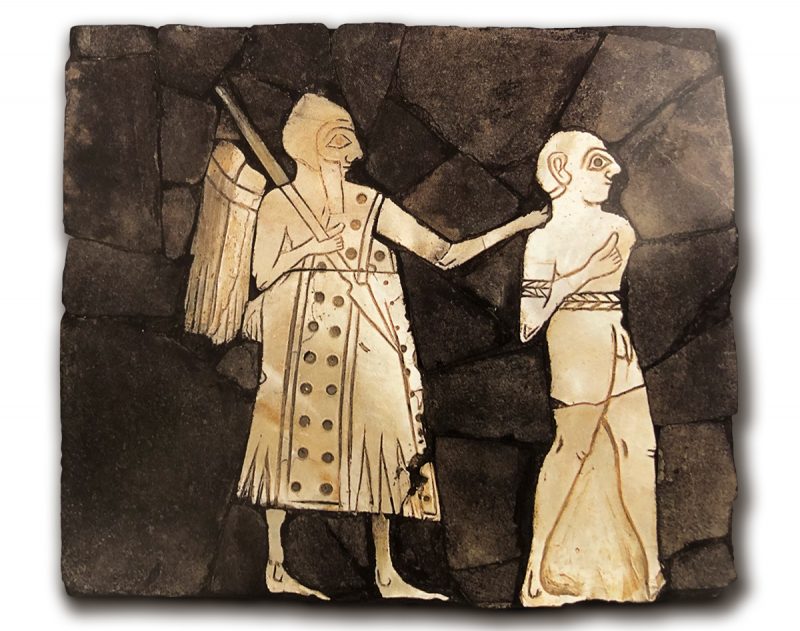
This piece would have been a fragment of a much larger scene. We see a soldier pushes forwards a prisoner in the front. The prisoner is naked, his arms tied to his chest with a rope.
This scene gives us an idea about the nature of military uniforms worn by the soldiers in Mari during the third millennia B.C. We see a long woolen dress that reaches below the knee, and a shawl decorated with circles supported to the left shoulder, that extends down to the bottom of the dress. The head of the soldier is covered with a cone-shaped hat covering the ears, and tied to the bottom of the chin. The soldier holds a spear in his right hand, leans it back against his right shoulder.
Along with many other similar paintings found at Mari, this would have been part of a mosaic in several panels intended to commemorate an important victory for the city king. However, the image should not be seen as narrating a specific event, but rather as expressing the idea of victory through the symbolism of the captured (destroyed) enemy. This interpretation is supported by the fact that the paintings were discovered in a temple and not in a room within the palace. This piece is made of mother-of-pearl and schist mounted on a base of schist and bitumen.






Leave A Comment