Description
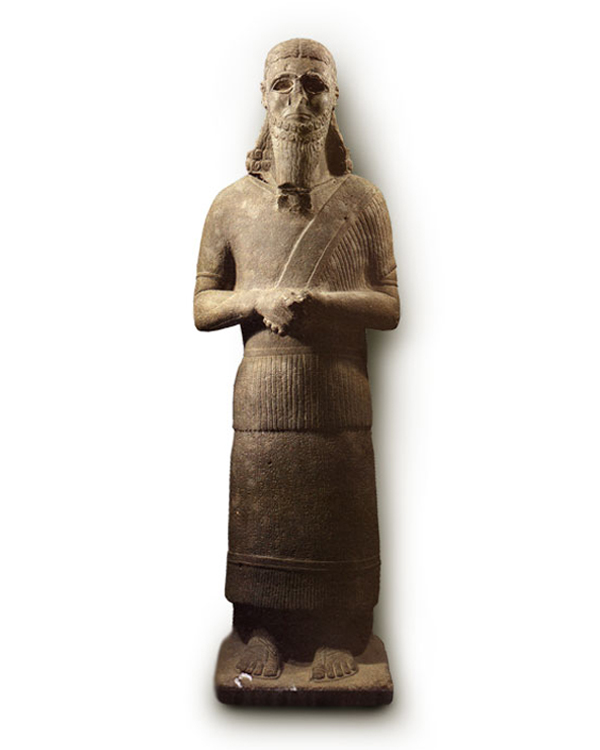
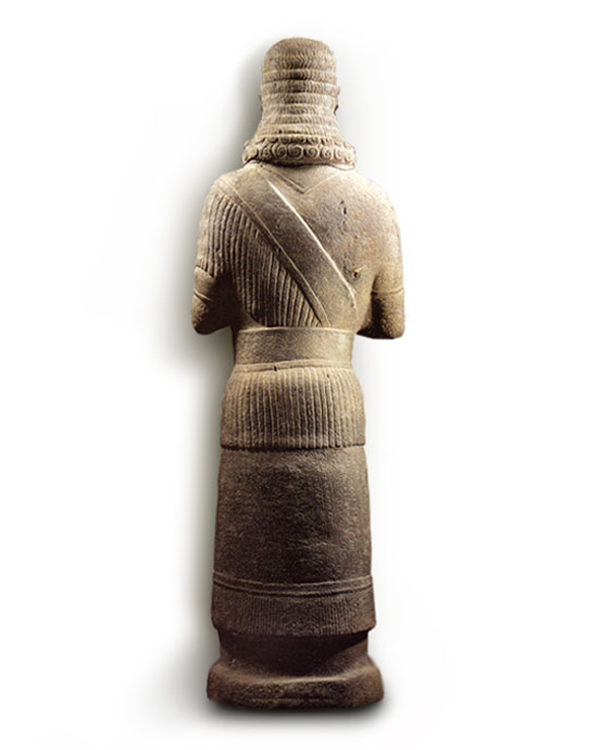
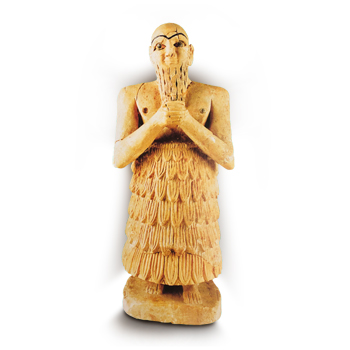
Discovered fortuitously in 1979 in northeastern Syria, at Tell Fekheryé (Fekharyeh), which is located on the Syro-Turkish borders at the sources of Khabur river, this statue presents a life-size figure standing, slightly arched, looking in front of him. A certain disproportion between the upper part and the lower part of the body is especially noticeable at the back of the statue. The curly locks of the hair, coordinated in concentric crowns, go down to the nape of the neck to be replaced at the shoulders by a double horizontal row of curls of hair. The forehead is quite high, topped with curved eyebrows. The deep eye sockets are surrounded by a thin rim which is supposed to mimic the eyelids. The reported eyes were not preserved and the nose has practically disappeared. The upper lip is suggested by a horizontal line located under the mustache. On the other hand, the lower lip is completely sculpted. The round cheeks are separated from the nose and mouth by deep corners. The ears are well formed. A full beard, distributed over the jaw in two vertical rows of curls, frames the face. The mustache ends on each side with two curls which merge with the curls of the beard itself. From the chin, the width of the beard decreases and its lower end which presumably ended in curls similar to those of the hair has been broken, probably during the separation of the head and the trunk. The arms are tight along the body; the hands are joined, the right encircling the left.
The feet are parallel but not joined; the toes are individualized and the cuticle of each nail is even shown. Only the anterior part of the feet is sculpted and the heels are merged with the apron which was left behind the plinth. The costume consists of a long tunic edged down around its entire circumference in a row of thin fringes, 10 cm high and approximately 1 cm wide, which fall to ankle height.
The collar cutout is a simple scooped hem in the round on the front and in a V-shape on the back. The sleeves are short and edged with a thin, smooth hem. The bust is partly covered with a shawl which is fitted in a drape. From the right hip, the shawl rises obliquely on the left part of the back and passes over the left shoulder. The shawl then descends obliquely on the bust, then it is concealed by the two joined hands. It consists of a strip approximately 10 cm wide, to which is assembled by means of a longitudinal stitching a series of fringes 20 cm high and 2 cm wide. The sandals have a simple flat sole that goes up slightly on each side of the foot. Two thin and smooth straps, with longitudinal stitching, sometimes single and sometimes double, passing through four straps fixed in the sole on either side of the foot, cross on the instep and end in a double loop. A vertical loop is made at the anterior end, in which the big toe is housed.
Inscriptions
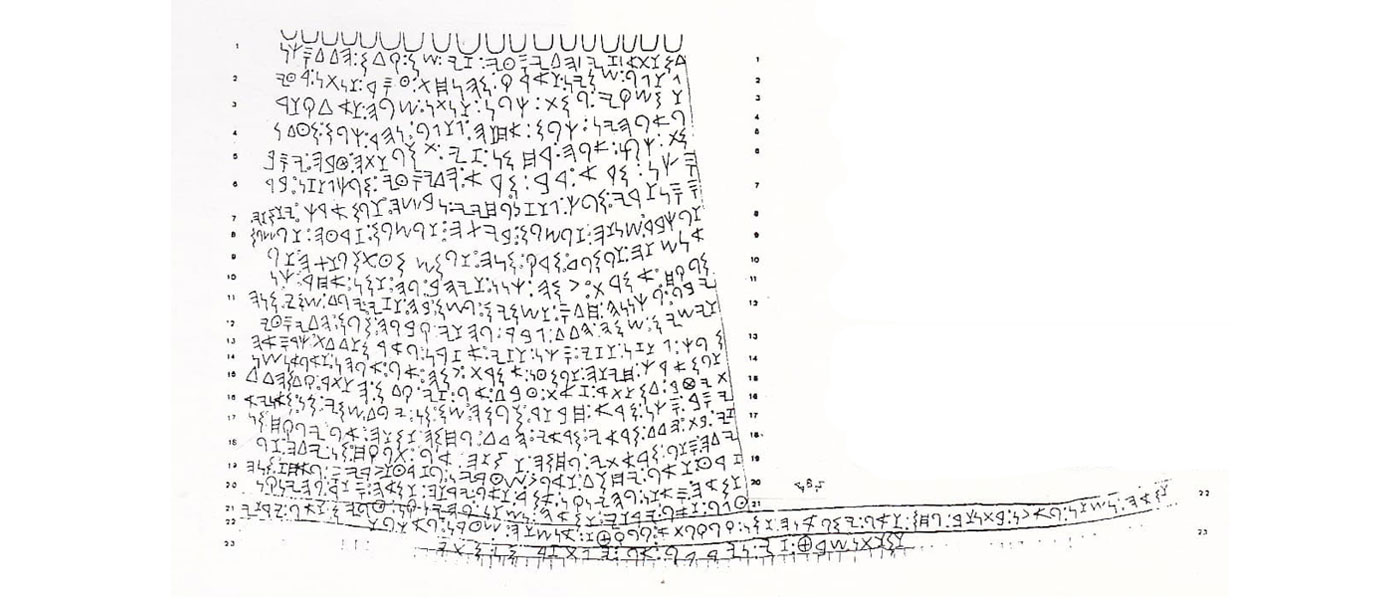
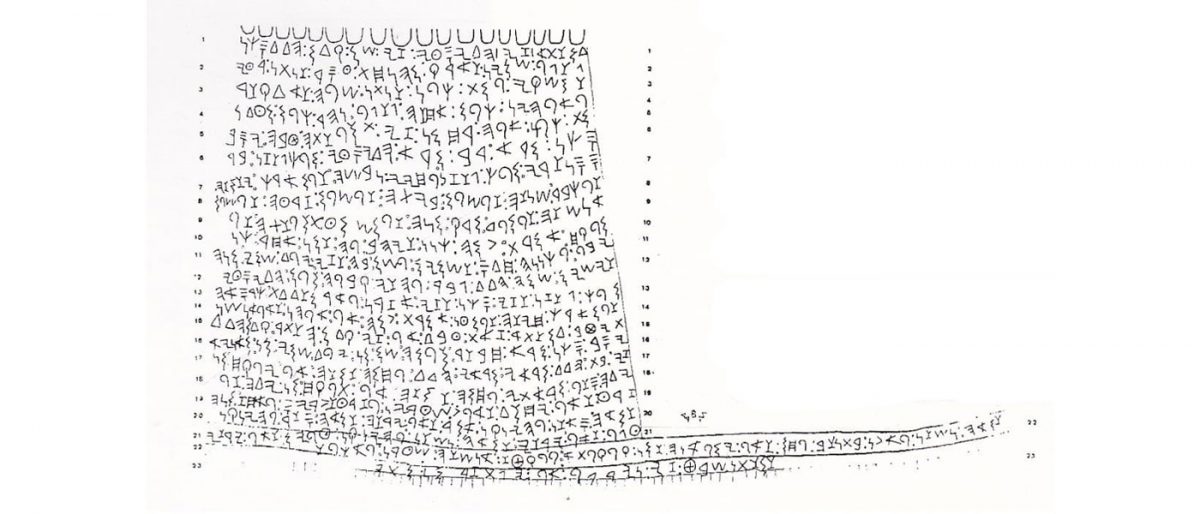
Between the belt and the lower fringes of the tunic are engraved two inscriptions. The first, engraved in Assyrian syllabic cuneiforms and 38 lines long, is incised on the anterior part of the tunic. The writing lines are not horizontal as on other Assyrian monuments of the same period, but are read vertically. Each entry line is separated from the next by a vertical line. The waistband and the lower fringes form the margins of the inscription to the border. The second inscription, engraved in linear characters belonging to the Aramaic alphabet and 23 lines long, ie 198 words, and comprising 733 fully legible letters, is incised on the rear part of the tunic. The writing lines are not regular and their spacing is variable as well as the dimensions of the letters.
Translation
Aramaic text
1) Representation of Hadadyisʻi which he placed before Hadad of SIKAN 2) Controller of the waters of the heavens and the earth, who pours out wealth and dispenses pastures and watered land 3) to all countries and provides peace and sustenance 4 ) to all the gods his brothers, Controller of all the rivers who make prosper 5) all the countries, merciful God to whom it is good to address his prayer, which remains 6) to SIKAN, the great Lord (his?) Lord. Hadad-yis-i king of GUZAN, son 7) of Shamash-nuri king of GUZAN, for the life of his soul and for the length of his days 8) and for the prolongation of his years and for the prosperity of his house and for the salvation of his descendants and for the salvation 9) of his people and to rescue him from sickness and for the answer to his prayer and for 10) his words to be received with favor, (the) erected ( e) and offered it to him. And whoever in the future 11) (it) will take away to erect (it) again let him put (my) name there, and whoever will erase my name 12) and (there) will put his name, whom Hadad the Hero is his adversary. Statue of Hadad-yisʻi 13) king of GUZAN and SIKAN and AZRAN. For the exaltation (?) And perpetuation of his throne 14) and for the prolongation of his life and so that his word may be acceptable to gods and men 15) he made this statue (and) made it better than ‘before. In front of Hadad 16) who lives in SIKAN, the Lord of KHABUR, he placed his statue. He who will erase my name from the furniture 17) of the house of my Lord Hadad, let my Lord Hadad not accept his food or drink from his hand! May Sawl my Lady not accept his food or drink from his hand! Let him sow and not reap! 19) And let him sow a thousand measures of barley and take out half of it! 20) And that a hundred sheep suckle a lamb without it being satisfied! And that a hundred cows suckle 21) a calf without it being satisfied! Let a hundred women breastfeed an infant without it being full! 22) And let a hundred women bake bread in the oven and not fill it! And from the garbage pit that its people glean barley! Let them eat! 23) But may the plague, the scourge of Nergal, not be eradicated from his country!
Assyrian text
1) To Adad, Controller of the waters of the heavens and the earth which pours out 2) wealth, who dispenses pastures and watered lands 3) to the people of all cities, who provides 4) shares and offerings 5) to the gods his brothers, Controller of waterways 6) who makes the whole world prosper, God merciful 7) to whom it is good to address his prayer which remains in GUZANA 8) to the great Lord his Lord Adad-it’i governor of GUZAΝΑ 9) son of Shamashnuri governor of GUZANA 10) for the life of his soul and for the length of his days 11) and for the prolongation of his years and for the prosperity of his house and for the salvation of his descendants 12) and of his people to wrest sickness 13) from his body and for the answer of my (!) prayer 14) so that my (!) words may be received with favor (Ha erected 15) and (it) offered (e) And whoever in the future will restore his ruin, 16) let (there) put (my) name 17) whoever will damage my name and ( y) will put his name, 18) that Adad the Hero is his opponent. 19) Statue of Adad-it’i governor of GUZANA 20) of SIKANU, of ZARANU. 21) For the prosperity (?) Of his throne for the extension of his reign 22) and so that his word may be pleasing 23) to gods and men, this statue he made 24) better than before. In front of Adad 25) who lives in SIKANU, the Lord of KHABUR 26) he placed his statue. He who will erase my name 27) from the furniture of the house of Adad my Lord 28) whom Adad my Lord 29) accepts neither food nor drink from him! May Shala my Lady 30) his food (and) his drink not accept from him! May he cultivate and 31) not reap! Let him sow a thousand measures of barley 32) and only take out one! Let not a hundred sheep satisfy 33) a lamb! Let not a hundred cows satisfy a calf! 34) that a hundred mothers do not satisfy one child! 35) Let a hundred bakers not fill an oven! In the garbage pits that gleaners glean! May disease, 38) plague and plague not be eradicated from his country!
Comments
This monument, discovered fortuitously and devoid of any archaeological context, would immediately reveal its exceptional importance because of the juxtaposition of a bilingual Assyro-Aramaic inscription of appreciable length, of an Aramaic version whose archaic writing presents elements new paleographic and several iconographic elements that would help fuel the discussion about the date of the statue and the inscriptions it bears. The general structure of the two inscriptions is similar: dedication of the monument to the storm god Hadad, whose cardinal virtues are listed; identity of the king of Guzan, dedicating the monument, with a view to benefiting from a long life and prosperity before gods and men; threats to any man who would like to appropriate the monument by removing the name of the first dedicator. The text should end here, but, without any break in continuity that is visible on the stone, a second inscription is carved in both versions; the dedicator has now added two cities to his domain and he has restored or even given a new medium to his dedications. Now the threats are aimed at the one who would erase the name of Hadad-yisʻi from the furniture of the temple of Hadad. Neither the latter nor his consort (Shala / Sawl) would welcome the request of the usurper and famine, sterility and epidemic would then come to attest that the divine couple obtained the support of the formidable Nergal to chastise the offender. However, a synoptic examination of the two texts shows that the two versions, Akkadian and Aramaic, are not the exact transfer from one another but that several sentences are more an adaptation than an induction. Moreover, a certain number of elements of one or the other text are not common to both versions … The first important nuance between the versions denotes the de facto subjection of the Aramaic wren to its powerful eastern neighbor. In lines 8-9 of Akkadian which were to be read by their Assyrian masters, Hadad-yis i and his father Shamash-nuri indeed each present themselves as governor of Guzana – šakin -, but in lines 6-7 of the Aramaic which were to be read by their own Aramaic-speaking subjects, they each introduce themselves as King of Guzan – MLK. Another divergence concerns the residence of the god, which the Akkadian version places at Guzana (1.7) but which the corresponding Aramaic text (1.6) places at Sikan. One can imagine that in an earlier phase of Hadad-yisói’s reign, there may have been two statues, one erected in Guzana, the other in Sikan, each bearing the lines 1-18 of the Akkadian and the lines 1-12 of Aramaic. The second text (Akkadian 1.19-38, Aramaic 1.12b-23) would have been engraved later, following the seizure of Hadad-yis-i on the left bank of the Khabur and the towns of Sikan and ‘Azran, the dynast keen to preserve the memory of his ancient piety towards Hadad, the god of Guzan; note here that Hadad-yis‘i means “Hadad is my salvation”. From a historical point of view, this difference between the two texts marks in any case the extension of the domain of the king of Guzana, perhaps thanks to Assyrian help. Finally, there is a big difference between the threats made against the one who alienates in any way the statue in the first and in the second part of the two texts. Brief in the first part of the inscription: “Let Hadad the Hero be his adversary” (Akkadian 1.18, Aramaic 1.12), in the second part on the other hand they cover the last eleven lines of the Akkadian version, the last seven lines of the Aramaic version and they involve three deities instead of just one.





Leave A Comment