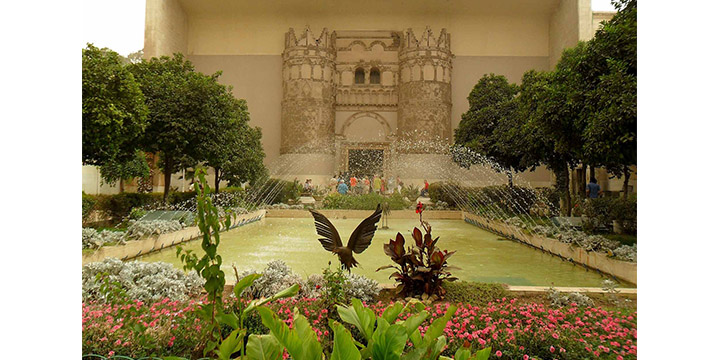
The National Museum of Damascus was established in 1919 under the supervision of the Ministry of Education, making it the first national institution dedicated to safeguarding Syria’s cultural heritage. Prince Jaʿfar al-Hasani (1892–1967), the first Director of Antiquities and Museums, played a pioneering role by collecting archaeological finds and preserving them in the ʿAdiliyya School in Damascus, which formed the nucleus of the museum’s early collection. During the French Mandate, the eminent archaeologist Henri Seyrig (1895–1973) contributed significantly to shaping modern archaeological administration in Syria and supported the expansion of the museum with systematic and scientific organization of its holdings.
Relocation and Expansion
In 1936, the discovery of the Umayyad Qasr al-Hayr al-Gharbi in the Syrian Desert prompted the decision to build a new museum adjacent to the Ottoman-era Tekkiye Sulaymaniyah, on a site that had partly served as barracks during the French Mandate. The monumental façade of the palace was carefully reconstructed to become the main entrance of the museum—an emblematic gesture affirming the presence of early Islamic heritage within the broader cultural fabric of Syria. Officially inaugurated in 1950, the museum continued to expand in the following decades, gradually evolving into a comprehensive national institution representing all phases of Syria’s history.
Significance of the Collections
The National Museum of Damascus houses an unparalleled range of artifacts spanning from prehistoric times to the Ottoman period. Its holdings include stone tools, cuneiform tablets, Ugaritic inscriptions of the world’s earliest alphabet, classical statues and mosaics, as well as Islamic manuscripts and artistic treasures. Through this diversity, the museum stands as a unifying platform for the identity of all Syrians, while offering a unique panorama that makes it a global scientific, cultural, and humanistic reference.
The Museum During the War
With the outbreak of the Syrian conflict in 2011, the museum was forced to close its doors and many of its most important artifacts were transferred to secure locations as part of emergency safeguarding measures. Despite the threats and dangers, the museum remained a symbol of resilience, and parts of its galleries reopened in 2018, gradually resuming its cultural and scholarly role.
About Us – Who We Are and Why We Do This
The Virtual Museum of Syria (VMS) is a non-profit cultural initiative launched by the organization Mirath for Cultural Heritage, founded by Syrian scholars in the diaspora. The project focuses on the systematic digital documentation of the collections of Syrian museums, following academic and research-based standards, and making them accessible in both Arabic and English to researchers, students, and the wider public. The aim is to ensure continued access to the heritage preserved in the National Museum of Damascus and other Syrian museums, recognizing it as a cornerstone of Syria’s cultural memory and an essential component of world heritage.