
Dederiyeh Cave:
A Window into the Prehistory of Syria
Significance
Excavations at Dederiyeh Cave have provided invaluable insights into the prehistory of Syria, marking it as a key site in understanding the broader Levantine region. The most significant discovery from the cave is a rare, almost complete Neanderthal child’s skeleton, intentionally buried within a pit and dating back to approximately 100,000 BC. Subsequent excavation seasons revealed three additional Neanderthal skeletons, further enriching our understanding of Neanderthal life and burial practices.
The clearly intentional nature of the burials, along with the tools found alongside the remains, underscores the cultural and behavioral complexity of Neanderthals. These findings are crucial for reconstructing the social and ritualistic behaviors of early humans. Notably, while many Neanderthal bones had been discovered previously, this was one of the first instances where an almost complete child’s skeleton was found in its original burial state, offering unprecedented opportunities for study (2).
Although many Neanderthal bones had been discovered already, this was practically the first time that an almost complete child’s skeleton had been found in its original burial state.
Discovery
On August 23, 1993 , a joint Japan-Syria excavation team made a groundbreaking discovery at Dederiyeh Cave. They unearthed fossilized Paleolithic human remains belonging to a Neanderthal child, estimated to have been about two years old. This child lived during the Middle Palaeolithic era, which spans from approximately 200,000 to 40,000 years ago. The discovery was particularly significant due to the completeness of the skeleton and its undisturbed burial context, providing a unique glimpse into Neanderthal life and death rituals.
Site Plan
The entrance to Dederiyeh Cave faces north towards the wadi and is accessible by climbing about 60 meters up from the valley floor. Another 10 meters further lies a secondary entrance known as the chimney. The current landscape around the cave is mountainous, open, and sparsely vegetated.
The cave itself is expansive, featuring a large chamber that is 15 meters wide and 10 meters high at the entrance, extending about 60 meters deep with a maximum width of 40 meters. At the back of the cave, a vaulted dome reaches a height of 10 meters. The Neanderthal infant’s skeleton was discovered under the chimney of the cave in 1993 (1).
Findings
The excavations at Dederiyeh Cave uncovered a wealth of human remains. Archaeologists estimate the minimum number of individuals represented by the skeletal parts to be approximately ten. Among these fossils are the first Dederiyeh child (Dederiyeh 1) from Burial No. 1 and the second Dederiyeh child (Dederiyeh 2) from Burial No. 2.
In addition to human remains, the cave yielded numerous animal fossils, including those of gazelles, deer, wild pigs, wild goats, wild sheep, foxes, and panthers. These animal remains were found in layers nearly contemporaneous with the Neanderthal skeleton. Recent research suggests that the climate and landscape of the area during the Neanderthal period were not significantly different from today, though possibly a bit drier (1).
References
- Muse Digital Archiving Frontiers
- Address: 2-1, Udagawa-cho, Shibuya-ku, Tokyo, Japan
- The Dederiyeh Neanderthal Website | Takeru Akazawa
Location Afrin Valley northwest of Aleppo some 400 km north of Damascus.
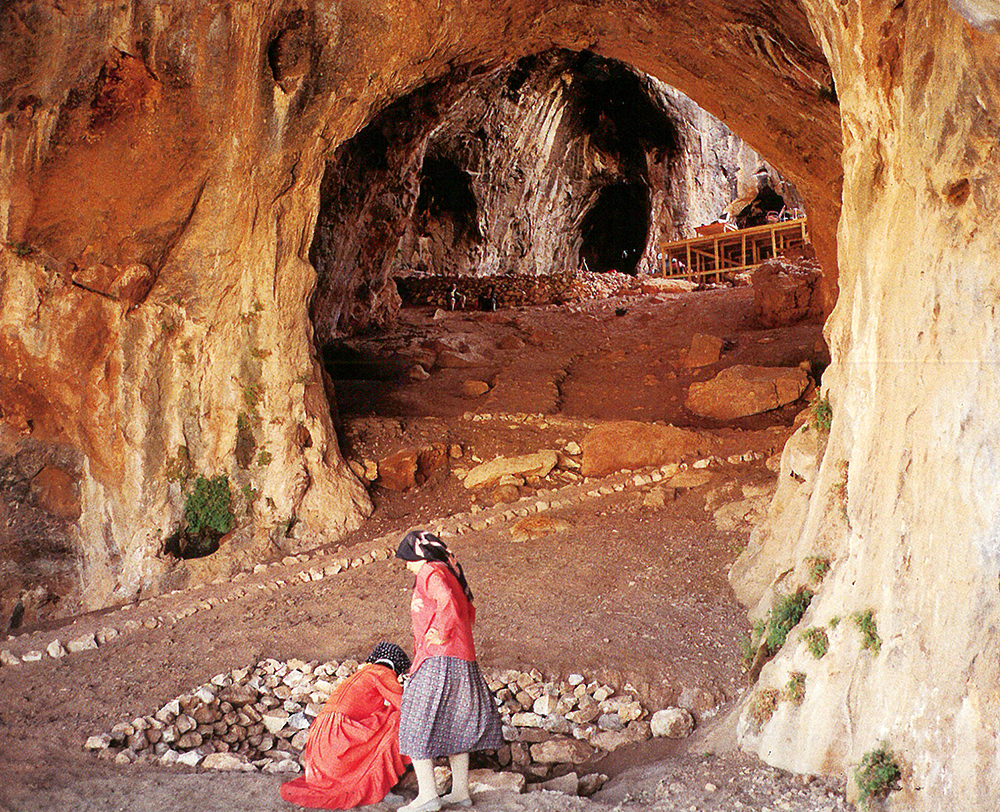
General view inside of the Dederiyeh cave (Image source Wikipedia)
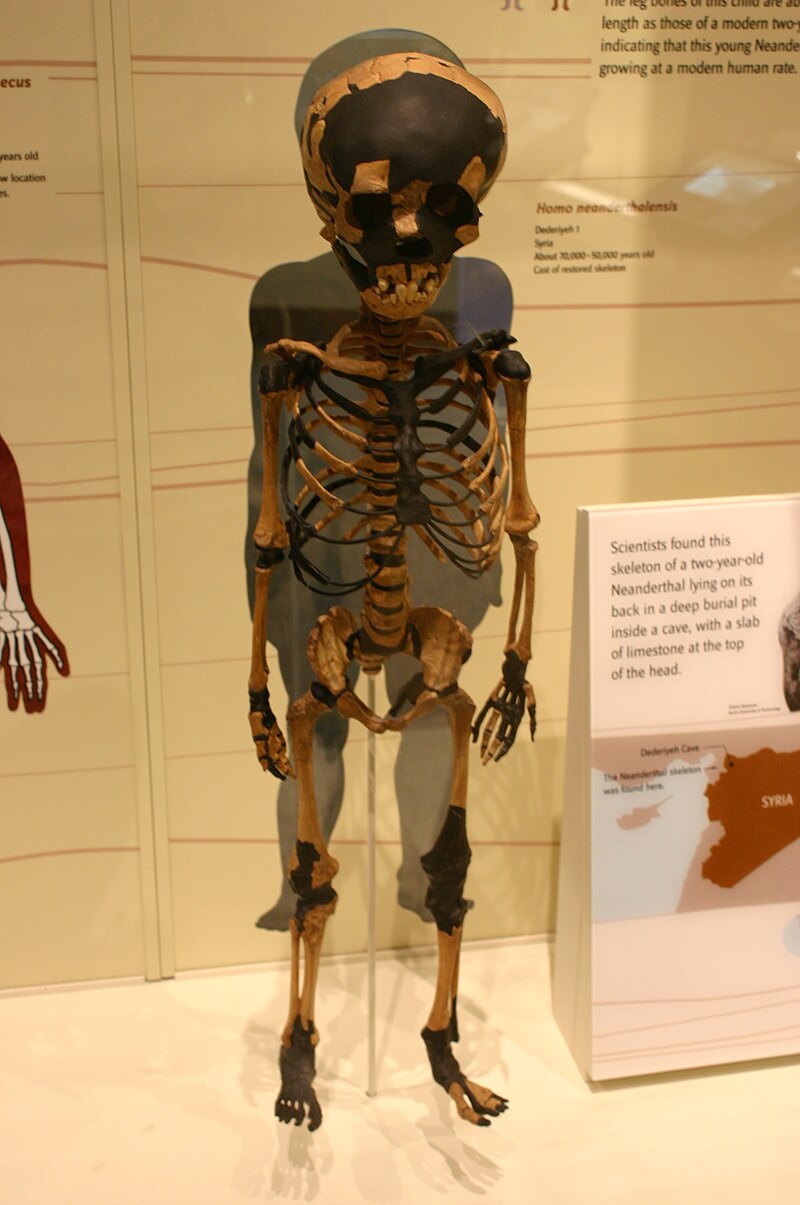
Dederiyeh 1.Two-year-old Neanderthal, dated 70 kya–50 kya (Image source from Wikipedia)