
Animal figurine
Description
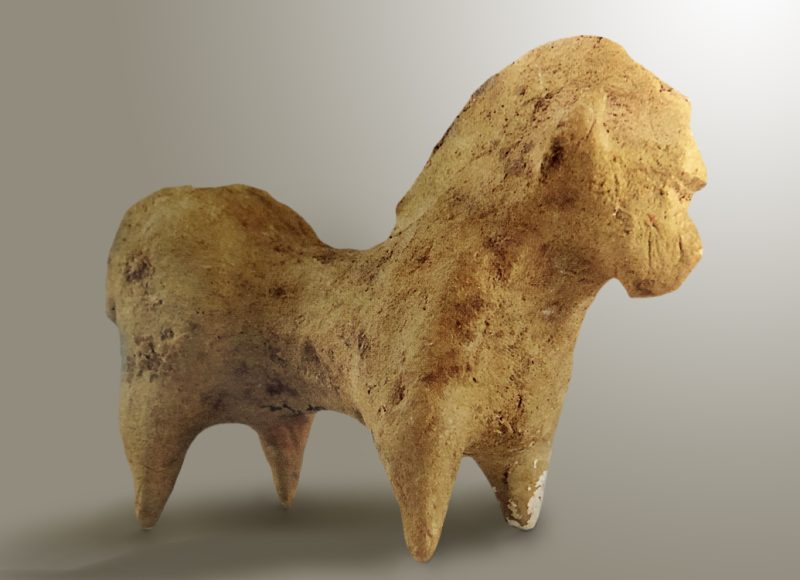
This item shows a small statuette of a four-legged animal, made of fired clay with an earthy, yellowish color, which appears to represent a horse. The body has a simplified and stylized form, with a slight exaggeration of anatomical details, consistent with the nature of early childlike or folk sculpture. This supports the hypothesis that the figurine was used as a children's toy.
Stylistic and Formal Characteristics
- Head and Neck: The head is characterized by a clear frontal protrusion, indicating a jaw and a nasal surface, despite the lack of precise definition of the features. The neck is thick and somewhat straight, connecting to the body smoothly without a prominent anatomical separation, which demonstrates the simplistic sculpting style.
- The Mane: One of the most prominent sculptural elements of this piece is the mane, which extends from the top of the head to the middle of the back. This mane has been rendered in a prominent and relatively oversized manner. It is not divided into individual locks of hair but rather appears as a single, smooth mass that visually indicates its length. This is a direct indication that distinguishes the domesticated horse from its wild counterpart, which was known for its short and bristly mane.
- The Body: The body is characterized by a compact and thick structure, executed in a style that balances abstraction and representation without adhering to realistic anatomical proportions. The middle part (the torso) is not detailed and lacks clear anatomical indicators such as shoulders or flanks, indicating that the overall form took precedence over details in this style.
- The Legs: The four legs are distributed symmetrically and extend from the body as short cones ending in pointed tips. The legs appear to have been sculpted as a continuous part of the body's main mass without clear separation. This reinforces the hypothesis that the piece was made to function as a children's toy, as this structural continuity enhances durability and prevents breakage.
Significance
This piece is considered one of the earliest known representations of the domesticated horse in the Fertile Crescent. The prominence of the long mane is an important visual indicator of an advanced stage of horse domestication—a stage that brought about a major transformation in human history in terms of transportation, agriculture, and warfare.
This piece was found at Tell Chuera, an archaeological site located in northeastern Syria, between the Balikh and Khabur rivers. The site constitutes a large and important ancient city, considered one of the earliest examples of urban organization with its planned layout of buildings, streets, and temples, as it witnessed early urban development during the Bronze Age.
Despite its small size and simple execution, this piece holds high historical and cultural value. It reflects the entry of the horse into people's daily lives, not only as a means of transport or a tool of war, but also as a familiar creature to children. This indicates the integration of the horse into the collective imagination since the third millennium BC.


Leave A Comment