
Seated figure of the singer Ur-Nanshe

Description
This sculpture of a seated musician is one of the most splendid works of art created by the Mari sculptors.
Iblul-il, king of Mari: Ur-Nanshe, the chief singer, dedicated this statue to N[inni-zazla” is the inscription on the shoulder. The divine name is damaged, and the meaning of the inscription is open to discussion.
The musicians of Mari were famous. Contemporary tablets from Ebla often mention “great” or “lesser” singers from Mari who served at Ebla. They are also mentioned in the Old Syrian period when the Assyrian ruler Shamsi-Adad asked his son to send singers from Mari to the king of Carchemish. From this period and from the time of the Third Dynasty of Ur we have texts describing the duties of a singer, who had to be able to play various stringed instruments as well as drums. First and foremost he served the palace and the temple, praising in song the gods and the king.
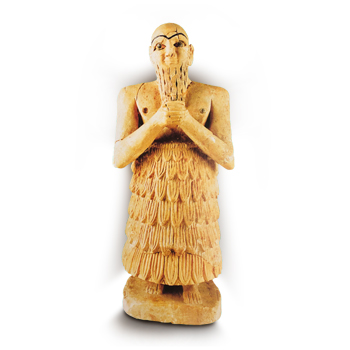
Ur-Nanshe is seated cross-legged on a low round cushion, with his tufted robe pulled over his knees. The arms and a support at the chest are lost. A fragment of the upper body of a similar statue holding a stringed instrument was found in the same room; the arms were held up by supports from the lower part of the body. The eye inlays of shell and lapis lazuli are preserved, while the inlays for the eyebrows have been lost. The long hair is dyed black, parted in the middle, and pushed back behind the ears. The wavy hair hangs down the back in long strands ending in curls.
The ruler Iblul-il, who is known from other dedicatory inscriptions at Mari, was the unlucky opponent of Enna-Dagan, a general from Ebla. Iblul-il also ruled the town of Abarsal, which is mentioned on the tablet shown in Cat. No. 80 as engaging in trade with Ebla.
*(Literature: A. Parrot Syria)




Leave A Comment