Iku-Shamagan, The King

The national museum of Damascus – متحف دمشق الوطني

Description

Iku-Shamagan (𒄿𒆪𒀭𒊭𒈠𒃶i-ku-Dsha-ma-gan) was a King of the second Mariote kingdom who reigned c. 2500 BCE. He is one of three Mari kings known from archaeology, Ikun-Shamash probably being the oldest one.[5] Another king was Ishqi-Mari, also known from an inscribed statue.

In their inscriptions, these Mari kings used the Akkadian language, whereas their contemporaries to the south used the Sumerian language.

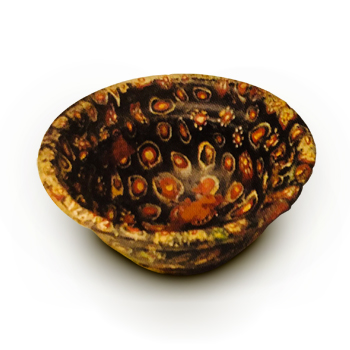
A vase mentioning Iku-Shamagan “in an early semitic dialect” is also known:

For Iku-Shamagan, king of Mari, Shuweda the cup-bearer, son of … the merchant, dedicated this vessel to the river god and Ishtarat

— Vessel inscription. (**)

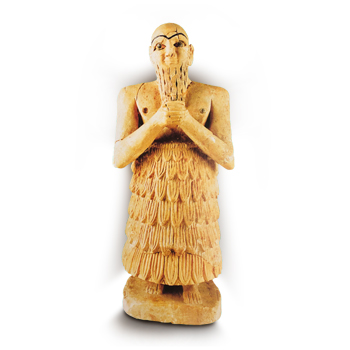
As a king, Iku-Shamagan is known from a statue with inscription, discovered by André Parrot in 1952. The statue, in the National Museum of Damascus, was restored by the Louvre Museum in 2011.

Iku-Shamagan’s votive statue was dedicated through an inscription on the back of the statue:

The national museum of Damascus – متحف دمشق الوطني

𒄿𒆪𒀭𒊭𒈠𒃶 / 𒈗𒈠𒌷𒆠 / 𒀋 / 𒊕𒂅 / 𒊨𒋤 / 𒀭𒈹𒍝𒍝 / 𒊕𒄸𒁺

i-ku-Dsha-ma-gan / lugal ma-ri2ki / abba2 / sa12du5 / dul3su3 / DMUSZ3xZA.ZA / sa12rig9

Of Iku-Shamagan, king of Mari, his surveyor has dedicated the statue to Ninni-zaza
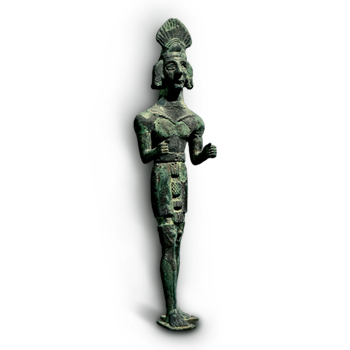
The statue was heavily damaged during the conquest by the armies of the Empire of Akkad circa 2300 BCE.

Iku-Shamagan  was Succeeded by Ishqi-Mari, whos statue now is in display at the national museum of Aleppo.

  • Site: Mari (Tell Hariri): Temple Ninni-zaza.

  • Date: C 2500 B.C

  • Material: Alabaster

  • Item Size : 115 cm (H)

  • Archaeological Mission:

  • National Museum Of Damascus (2011) – Museum Number:

  • VMS Code: Dam 028

Excavation Site Location

  • Aruz, Joan, ed., with Ronald Wallenfels. Art of the First Cities: The Third Millennium B.C. from the Mediterranean to the Indus. New York: Metropolitan Museum of Art; New Haven, CT: Yale University Press, 2003, p. 148.
  • Lambert, Maurice. “Les inscriptions des temples d’Ishtarat et de Ninni-zaza.” Revue d’Assyriologie et d’archéologie orientale 64, no. 2 (1970): 168–171.
  • المديرية العامة للآثار والمتاحف. الحوليات الأثرية السورية. المجلد الثاني، الجزآن الأول والثاني. دمشق: المديرية العامة للآثار والمتاحف، 1952، ص 173.
  1.  Parrot, André (1953). “Les fouilles de Mari Huitième campagne (automne 1952)”. Syria30 (3/4): Plates XXI-XXII. doi:10.3406/syria.1953.4901ISSN 0039-7946JSTOR 4196708..
  2. Art Of the first cities | Google Books 

Your Content Goes Here

  • Dam 028 / SLC

Not every record you will find here is complete. More information is available for some works than for others, and some entries have been updated more recently. Records are frequently reviewed and revised, We welcome any additional information you might have.

Record Completion 70%